Skip to content
HealthTech Research Centre Network
  • Home
  • About
    • Our partners
    • Collaboration Challenge Fund
    • HealthTech Forum
  • Support and services
    • Net Zero Catalyst
    • Navigating the HRCs
    • Involvement & inclusion
  • News and events
    • News
    • NIHR20
    • Events
    • Past events
  • Contact
Back to top Go to content
Menu
  • Home
  • About
    • Our partners
    • Collaboration Challenge Fund
    • HealthTech Forum
  • Support and services
    • Net Zero Catalyst
    • Navigating the HRCs
    • Involvement & inclusion
  • News and events
    • News
    • NIHR20
    • Events
    • Past events
  • Contact
Back to top Go to content
HealthTech Research Centre Network Logo
  • Home
  • About
    • Our partners
    • Collaboration Challenge Fund
    • HealthTech Forum
  • Support and services
    • Net Zero Catalyst
    • Navigating the HRCs
    • Involvement & inclusion
  • News and events
    • News
    • NIHR20
    • Events
    • Past events
  • Contact

Support and services

NIHR network icon

How we support innovators

  • Broader technology focus
  • Strategic alignment with NHS priorities
  • Full lifecycle support from research translation to NHS adoption
  • Coordination with wider NIHR infrastructure
  • Tailored support for industry, with a particular focus on small and medium enterprises (SMEs)
  • Regulatory readiness, delivered in partnership with UK regulatory bodies

We combine NHS clinical leadership, academic rigour, and industry insight to support technologies from early development through to NHS adoption, leveraging the full range of the NIHR’s research infrastructure.

We conduct robust investigations to provide real world evidence that demonstrates the economic value and public benefit for the NHS and its patients.

Patients and the public are partners in our work, shaping research and product development from initial conception through to adoption.

We partner with industry, universities, NHS organisations and patient groups to translate innovation into care.

We work closely with regulatory bodies including The Medicines and Healthcare products Regulatory Agency (MHRA) and The National Institute for Health and Care Excellence (NICE), and industry associations including The Association of British HealthTech Industries (ABHI) and The British In Vitro Diagnostics Association (BIVDA), to ensure our support aligns with regulatory requirements and industry needs.

We support innovators to apply for funding to provide the necessary capital to continue product development, and ensure they can generate the evidence necessary to apply for regulatory approvals.


To access i4i PDA grant writing resources please fill out this short form.

Net Zero Catalyst


Introduction to the Catalyst

What we expect from you

What you'll learn

Course structure

Frequently Asked Questions


Applications are currently closed for the NIHR Net Zero Catalyst. Our first cohort started in Spring 2026, culminating in a virtual showcase event in June 2026. The second phase of the Catalyst will be announced in Autumn 2026. 


Introduction to the Catalyst

The National Institute of Health and Care Research have partnered with the product design consultancy Pd-m to deliver the NIHR Net Zero Catalyst. The three-month programme offers innovators hands-on support from academic, clinical and industry expertise in sustainability and HealthTech, providing practical approaches to embed sustainability in product development. The Catalyst is delivered in partnership with Pd-m, sustainability and product design specialists.


In alignment with the DHSC ‘Design for Life’ framework for establishing a circular economy of reuse, remanufacture and recycling in medical products, this three-month CPD accredited Catalyst equips innovators with practical approaches and knowledge to embed sustainability within their innovations.


A £5,000 prize fund will be awarded to exceptional innovators participating in the Catalyst to support future development and evidence generation for follow-on funding applications. Each cohort has 10 places and there are now no joining fees for this year's cohort.


What we expect from you

Applicants to the Catalyst will be expected to:

  • demonstrate a basic level of carbon literacy, including an understanding of Net Zero and carbon emissions
  • be developing a HealthTech innovation, at technology readiness levels 2 – 4 (later-stage innovations may be considered, by exception)
  • be seeking funding for further development of the innovation
  • have a commitment to embedding sustainability into practice


What you'll learn

By the end of the Catalyst, participating innovators will understand:

  • how to integrate sustainability into their innovation
  • NHS Net Zero targets, future Greener NHS strategy, and their implications on the company’s practices
  • how to develop their sustainable value proposition for the NHS and the wider health and care system

Innovators will also receive continued support from the Catalyst as their innovation progresses, including an expert panel feedback session. This support, alongside new knowledge, practical approaches and partnerships gained by innovators, will place them in a stronger position for future developmental funding. Successful completion of the programme will result in a CPD accredited certificate of attendance.


Catalyst structure


March 2026, online, 2 hours - The Catalyst team will set the stage for the programme, provide an overview of sustainable healthcare, and task the cohort with a self-study activity on Net-Zero policy in the NHS.

April 2026, in-person (Leeds, UK), 7 hours - The cohort will learn about Life Cycle Mapping, Hot-Spot Analysis, and Circular Economy strategies. The Catalyst team will work with each member of the the cohort to identify specific approaches, opportunities and benefits of applying these theories in their HealthTech innovations.
Following Session 2, online, 1 hour - Each member of the Catalyst will receive a bespoke, individual assessment and coaching on the Life Cycle Maps and Circular Economy interventions they have developed during and following session 2.

May 2026, online, 6 hours - The cohort will reflect on their learning from the first three sessions with peers from the Catalyst cohort, learn the principles of developing a Sustainable Value Proposition, and how to target this specifically to NHS procurement processes, and analyse the HealthTech funding landscape. The cohort will start developing a pitch that integrates their Sustainable Value Proposition, in preparation for the next session (Innovation Showcase).

June 2026, 2-3 hours - Each member of the Catalyst cohort will develop and deliver a final pitch for their innovation, highlighting how they have integrated learning from the Catalyst. Awards and prize funds for exceptional innovators will be announced, and each member of the cohort will receive a 1-to-1 post-programme debrief with the Catalyst team.

Approximately 8 hours, across the Catalyst - The cohort will be asked to complete activites started in one session ready for following sessions. Tasks include background research, refining and digitising work from the in-person workshop and developing a value proposition and 3-minute pitch video. In completing self-study activities, the cohort will have the opportunity to intregate Catalyst teaching into their HealthTech innovation. Support will be available from the Catalyst team throughout self-study.


Frequently Asked Questions

The prize fund will be shared with innovators that have demonstrated the biggest progress over the course of the programme. The fund will be awarded under the condition that it is used to support innovators move towards their sustainability goals. Examples include funding design consultations, evidence generation or device assessment in research facilities.

For the spring ’26 cohort we will not be taking on purely digital innovations as we don’t feel the current format would benefit your innovation. We do however recognise digital HealthTech's potential for significant sustainability gains through patient pathway improvements. It is our ambition to include digital in future cohorts.

So long as there is a physical device this type of innovation is welcome. The programme focuses on manufacture, materials and related circular practices which aren’t relevent to a purely digital innovation.

The Catalyst is open to all; however, innovators from outside the UK should aim to bring their innovation to the UK market, either through introduction to the NHS or by seeking to access NIHR funding in partnership with UK collaborators to support further development. Please note that cohort members are expected to attend in‑person events in the UK, and travel costs are not covered by the programme. To date, we have had engagement in the Catalyst from organisations across Europe.

The Catalyst primarily focuses on teaching the processes and principles required. All discussions will be held at a high level, and we respect any details you do not wish to share due to commercial sensitivity.

Applying circular principles early makes them much easier to implement, particularly when they relate to material choices or business model changes. While our primary focus is on innovations at TRL 1–4, applicants at higher TRLs are also welcome and will be considered on a case‑by‑case basis. In these cases, having already completed some sustainability‑related work on your innovation will be viewed favourably, as it demonstrates a willingness to adopt sustainable practices such as those taught in this programme.


For more information watch our information session recording.


The Net Zero Catalyst is led by a partnership of the following organisations:

Pd-m: Founded in 2005, Pd-m is a Product Design and Sustainability consultancy with a focus on Health Technologies. The business works with a range of clients including boot-strapped start-ups to med tech multinationals, to embed sustainability into their organisations at a strategic and practical level.

NIHR Climate, Health & Sustainability (CHS): Responsible for NIHR’s mission to drive and promote sustainable health and care systems. The CHS team supports this mission by funding research, supporting knowledge mobilisation and building research capacity in climate, health and environmental sustainability.

NIHR HealthTech Research Centre Network: provides strategic leadership and coordination for NIHR’s 14 HealthTech Research Centres (HRCs). The Network’s ambition is to transform UK healthtech into a thriving ecosystem of industry, academia, and the NHS, bringing innovative healthtech solutions to patients more rapidly and driving economic growth.

NIHR HealthTech Research Centre in Accelerated Surgical Care: drives HealthTech innovation to deliver socio-economic benefit, through quicker diagnosis and treatment of surgical conditions. Sustainability and Net Zero is a cross-cutting research theme that focuses on the methods and technologies needed to reduce waste and promote sustainability.


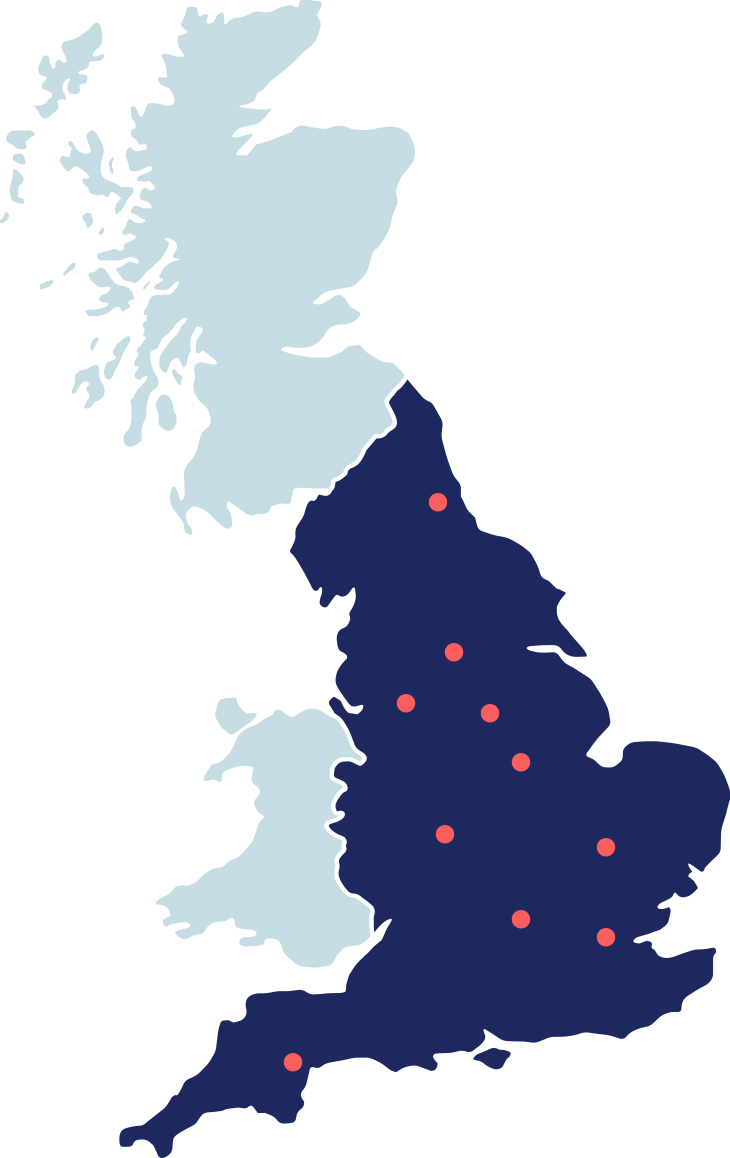
Centre locations

The 14 HealthTech Research Centres are based in leading NHS organisations across England.

Each centre operates on a national scale, with different clinical specialties.

Map of the UK marking locations of HealthTech Research Centres The next article contains links to each centre's website

Newcastle

NIHR HealthTech Research Centre in Diagnostic and Technology Evaluation

Leeds

NIHR HealthTech Research Centre in Accelerated Surgical Care

Manchester

NIHR HealthTech Research Centre in Emergency and Acute Care

Sheffield

NIHR HealthTech Research Centre in Long Term Conditions

NIHR HealthTech Research Centre in Paediatrics and Child Health

Nottingham

NIHR HealthTech Research Centre in Mental Health (MindTech)

NIHR HealthTech Research Centre in Rehabilitation

Birmingham

NIHR HealthTech Research Centre in Devices, Digital and Robotics

Cambridge

NIHR HealthTech Research Centre in Brain Injury

Oxford

NIHR HealthTech Research Centre in Community Healthcare

London

NIHR HealthTech Research Centre in Cardiovascular and Respiratory Medicine

NIHR HealthTech Research Centre in In Vitro Diagnostics

NIHR HealthTech Research Centre in Brain Health

Exeter

NIHR HealthTech Research Centre in Sustainable Innovation

Support through the HealthTech lifecycle

By harnessing the trusted expertise of all HRCs, we offer a unified, coordinated approach that provides HealthTech companies with the support they need, shaped around their specific challenges and goals.

Creation, Prototyping

TRL 1-2, TRL 3

Identify and support seed funding applications and experimental and translational research funding (e.g., EPSRC, MRC, VCSEs)

Clinical Evaluation

TRL 4-6

Applications to larger grants to support clinical trials (e.g., UKRI, i4i FAST)

Regulation, Evaluation & Guidance

TRL 7

Applications for Heath Technology Assessment for evidence synthesis research

Commercialisation, Scaled Adoption

TRL 8, TRL 9

Identify and apply for venture capital funding for commercialisation

Creation

TRL 1-2

Identify and validate unmet patient need

Prototyping, Clinical Evaluation

TRL 3, TRL 4-6

Usability testing across different patient populations at a national level

Regulation

TRL 7

Provision of patient involvement evidence to support application

Evaluation & Guidance, Commercialisation

TRL 7, TRL 8

Content, visual design, reliability, language and user instructions

Scaled Adoption

TRL 9

Patient experience, benefits, risks and unexpected events

Creation

TRL 1-2

Unmet need validation

Creation, Prototyping

TRL 1-2, TRL 3

Care pathway analysis

Prototyping, Clinical Evaluation

TRL 3, TRL 4-6

Analytical validity and proof of concept

Clinical Evaluation, Regulation, Evaluation & Guidance

TRL 4-6, TRL 7

Clinical validity and evaluation

Evaluation & Guidance, Commercialisation, Scaled Adoption

TRL 7, TRL 8, TRL 9

Regulatory approval and real world evidence

Commercialisation, Scaled Adoption

TRL 8, TRL 9

NICE approvals

Creation

TRL 1-2

Develop value proposition

Prototyping, Clinical Evaluation

TRL 3, TRL 4-6

Early health economics (e.g., value drivers, uncertainty modelling, pricing strategy)

Clinical Evaluation, Regulation, Evaluation & Guidance, Commercialisation

TRL 4-6, TRL 7, TRL 8

Full health economics (e.g., Cost-Minimisation, Effectiveness, Benefit, Consequence Analysis, including Quality or Disability-Adjusted Life Year (QALY/DALY))

Scaled Adoption

TRL 9

Adherence to NHS Supply Chain requirements for procurement

Creation

TRL 1-2

Knowledge and guidance for NHS care pathways

Prototyping

TRL 3

Access to clinical champions

Clinical Evaluation

TRL 4-6

Access to clinical engineering to support evidence generation

Regulation, Evaluation & Guidance

TRL 7

Access to Clinical Research and Innovation Governance

Commercialisation

TRL 8

Access to commercialisation expertise through Trust partnerships (e.g., Medipex)

Scaled Adoption

TRL 9

Access to NHS Supply Chain and other adoption specialists

Creation

TRL 1-2

Identify and embed carbon savings in design stage to meet sustainability (net zero) requirements

Prototyping

TRL 3

Develop a sustainable value proposition (circularity)

Clinical Evaluation

TRL 4-6

Health econometrics support to demonstrate sustainability gains (financial and health)

Regulation, Evaluation & Guidance

TRL 7

Provide evidence of meeting sustainability (net zero) requirements

Evaluation & Guidance, Commercialisation

TRL 7, TRL 8

Complete Evergreen Assessment an Carbon Reduction Plans in preparation for procurement

Commercialisation, Scaled Adoption

TRL 8, TRL 9

Adhering to NHS Net Zero requirements for registration and procurement frameworks (i.e., NHS Supply Chain)

Creation

TRL 1-2

Build entrepreneurship skills including grantsmanship

Prototyping

TRL 3

Product design capability (PPIE & Sustainability, value based procurement)

Clinical Evaluation

TRL 4-6

Certified health econometrics training to support evidence generation

Regulation, Evaluation & Guidance

TRL 7

Virtual regulatory training on evidence generation, legal compliance and certification

Commercialisation

TRL 8

Access to accelerators, mentorship and placements to develop commercialisation skills

Scaled Adoption

TRL 9

tbc: NHS Supply Chain training/webinar

Creation, Prototyping

TRL 1-2, TRL 3

Utilise regulatory partnerships to design evidence generation to overcome regulatory barriers

Clinical Evaluation

TRL 4-6

Collaborate across NIHR Infrastructure to test prototypes and utilise clinical trial facilities and populations

Regulation, Evaluation & Guidance

TRL 7

Utilise HRC partnerships with MHRA and NICE partnership to support regulatory approvals, Evaluation and development of Guidance

Commercialisation

TRL 8

Establish collaboration partnerships to support commercialisation

Scaled Adoption

TRL 9

Utilise HRC partnerships with NHS Supply Chain and other adoption specialists

Connect

Sheffield Teaching Hospitals NHS Foundation Trust,
D33 Royal Hallamshire Hospital,
Sheffield,
S10 2JF

hrc_network@nihr.ac.uk

Linkedin logo Instagram logo

Collaborate

Work with us

Work with the HRCs

Funded by

NIHR Logo

Privacy policy | Accessibility statement

HRC Intranet

Website by Volute

Icon: This website is powered by 100% renewable energy
Icon: Click here to find out more