


As new targets and measures for sustainability in healthcare move closer to reality, new HealthTech innovators have to increasingly consider the sustainability of their products and practices. NIHR’s new Net Zero Innovation Catalyst aims to equip innovators with the skills and knowledge they need to respond effectively to this challenge early on in product development.
The challenges facing modern healthcare are two-fold. Technological innovation is necessary to drive improvements to patient outcomes and productivity, while recognising healthcare’s significant contribution to global emissions. If the global health care sector were a country, it would be the fifth-largest greenhouse gas emitter on the planet. As the NHS responds with ambitious Net Zero targets that will soon expand to the wider supply chain, innovators of new medical devices, diagnostics and technologies (collectively known as HealthTech) play a critical role in reducing healthcare emissions. Medical devices and associated equipment and clinical consumables are significant contributors to NHS carbon emissions. Innovators are well-placed to embed sustainability into their new HealthTech products from an early stage, but the roadmap to developing sustainable technology, and its benefits, are not always apparent.
Circular economy principles
Developing a circular economy is an important step to achieve financial and environmental sustainability globally, for the HealthTech sector and many others. In total, 45% of global emissions are attributable to production activities, which is only addressable by developing circular economies.
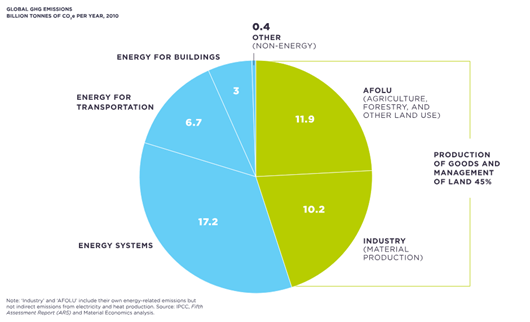
45% of global greenhouse gas emissions can be attributed to the production of materials, products, and food, and to land management.
The current, linear economy extracts resources to manufacture products and dispose of them when used or expired. Alternatively, a circular economy embeds methods to reuse, refurbish and recycle products across its life cycle. Resource use and waste are minimised, enabling long-term savings in carbon emissions and costs. There is an active vision for developing a circular economy for HealthTech in the UK, driven by the Department for Health and Social Care’s Design for Life roadmap.
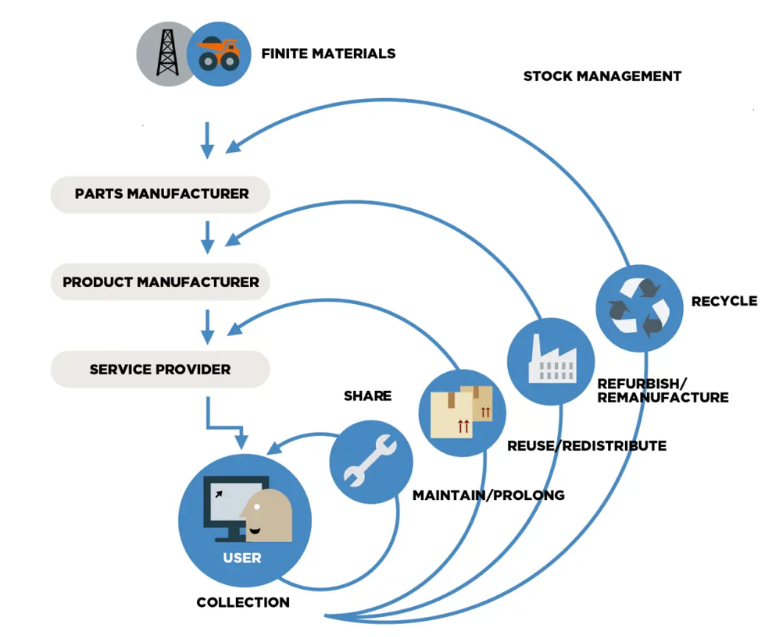
The most effective way of retaining the value of products is to maintain. Reuse, refurbish and recycle them, visible through this technical cycle.
In practice, circular economy principles are a core component of the modern HealthTech business model. It mandates a transition from single-use product sales to service-focussed models that enable reuse, modularity and repairability in products.
Supporting innovators to embed sustainability
NIHR’s Net Zero Innovation Catalyst is a hands-on 3-month programme, designed to be interactive and practical. Using a mix of in-person and remote learning, a cohort of 10 innovators work through the Catalyst to embed sustainability in their HealthTech products. The expertise they receive from the programme will directly impact and improve their current product development and benefit from peer reflection and feedback throughout.
Participants move through 5 key sessions, guiding them from the fundamentals of NHS Net Zero policy to the complexities of Life Cycle Mapping, Hot-Spot Analysis and Sustainable Value Propositions. Innovators learn to track the carbon footprint of their product from raw material extraction to end-of-life disposal, identifying exactly where carbon and cost savings can be made.
Partnership in delivery
The Net Zero Innovation Catalyst is a collaborative venture, delivered in partnership between the NIHR and Pd-m, a leading product development consultancy.
This partnership brings together diverse expertise that provides participating innovators with access to:
- clinical insights, understanding how products are used in care pathways.
- academic theory that wraps around sustainability and evidence generation methods.
- industry leading design and manufacturing advice.
The programme builds upon a successful pilot delivered by the NIHR HealthTech Research Centre in Accelerated Surgical Care and Pd-m earlier this year.
Next steps
If you are an HealthTech innovator with an interest in sustainability, the application window for the Catalyst is now open and closes on 30 January 2026.
More information about the Catalyst can be found here, including qualifying criteria and how to apply. The team delivering the Catalyst are holding an open, virtual Q&A on 12 January 2026, which is open for registrations. In addition, any questions can be directed to the NIHR HealthTech Research Centre Network, via
Notes
The Net Zero Catalyst is led by a partnership of the following organisations:
- NIHR Climate, Health & Sustainability (CHS): drives and promotes NIHR’s mission for sustainable health and care systems. The CHS team supports this mission by funding research, supporting knowledge mobilisation and building research capacity in climate, health and environmental sustainability.
- NIHR HealthTech Research Centre Network: provides strategic leadership and coordination for NIHR’s 14 HealthTech Research Centres (HRCs). The Network’s ambition is to transform UK HealthTech into a thriving ecosystem of industry, academia and the NHS, bringing innovative HealthTech more rapidly to patients and driving economic growth.
- NIHR HealthTech Research Centre in Accelerated Surgical Care: drives HealthTech innovation to deliver socio-economic benefit, through quicker diagnosis and treatment of surgical conditions. Sustainability and Net Zero is a key research theme, focussing on the methods and technologies needed to reduce waste and promote sustainability.
- Pd-m; product development consultancy with specialist skills and experience in product design and sustainability.