

Respiratory syncytial virus (RSV) is a common infection in young children and can cause serious breathing difficulties, sometimes requiring hospital treatment. Because RSV spreads easily, quickly identifying whether a child has the virus can help healthcare teams make decisions about their care and use hospital resources effectively.
The NIHR HealthTech Research Centre: Diagnostic and Technology Evaluation (HRC DTE) worked with Roche Diagnostics, the NHS and parent groups to independently evaluate a rapid RSV test for children. The study found that the Roche cobas® Liat system was highly accurate compared with standard laboratory testing, while providing results much sooner.
The test reduced the median time from taking a sample to receiving a result from around 29 hours to approximately 36 minutes. The study's economic modelling estimated potential NHS savings of around £62 per patient, equivalent to more than £1.8 million each year if the test were adopted at scale.
The technology is now in use across around 23 NHS trusts, and the project has led to further collaboration between the HRC and Roche Diagnostics.
Why is this work important?
RSV is highly contagious and is a common cause of bronchiolitis in babies and young children. When children with suspected RSV arrive at hospital, clinicians need to establish as quickly as possible whether they have the virus so that they can provide appropriate care and take steps to reduce its spread.
Traditional laboratory testing can take many hours. In the study, the median time for laboratory results to become available to clinicians was 28.9 hours. By comparison, the rapid test provided a result in a median of 0.6 hours, or around 36 minutes, from when the sample was taken.
A faster diagnosis could help healthcare teams make decisions sooner, including how best to manage a child's care and whether isolation is needed. It could also help hospitals make better use of limited isolation space and other resources.
The challenge was therefore not simply finding a test that was fast. The NHS also needed evidence that a rapid test could provide results that were sufficiently accurate and offer value for money.
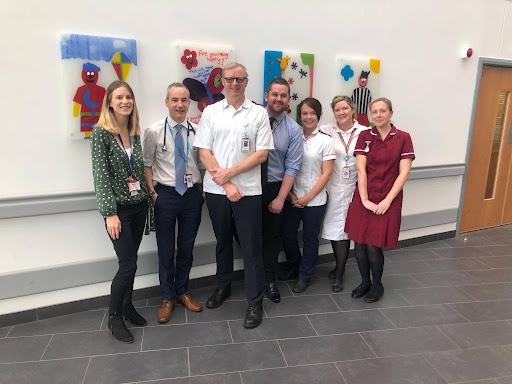
From left to right: Dr Joy Allen, Professor Malcolm Brodlie and the study team at Great North Children’s Hospital (Phil Woodsford, Stephen Crulley, Frances Baxter, Ashley Bell and Karen Morton)
How did the NIHR HealthTech Research Centre: Diagnostic and Technology Evaluation help to tackle this challenge?
The HRC was commissioned by Roche Diagnostics to independently evaluate the accuracy and potential economic benefits of the Roche cobas® Liat system.
A clinical champion, Professor Malcolm Brodlie, led the study and helped connect the HRC with frontline services, supporting access to the clinical settings and helping the study run effectively.
The study involved 186 children under two years old presenting with respiratory illness at the Great North Children's Hospital in Newcastle and Sunderland Royal Hospital. Samples were tested using both the rapid test and standard laboratory methods, allowing the researchers to compare their results.
The HRC DTE provided the methodological expertise, governance and coordination needed to deliver the study across the two NHS sites. This included:
- Providing expert input into the study design, working with Roche to make it as relevant to the NHS as possible
- Analysing and disseminating the results from the diagnostic accuracy study, care pathway analysis and economic modelling
- Embedding meaningful Patient and Public Involvement and Engagement (PPIE) throughout the project
- Helping to rapidly set up and organise the clinical study so it was ready to be conducted in time for the Winter 2017-18 season
- Coordinating the study across two sites, supporting the NHS trusts to complete the study and recruit to schedule. This included one hospital that had not previously taken part in paediatric studies
Importantly, parents of children under 2 were involved in shaping the research through co-developing study documents and taking part in focus group discussions and interviews. Their contributions improved the clarity of the parent/guardian information sheet and the poster advertising the opportunity to take part in the study. This ensured that the team recruited the desired number of patients in the optimal time. Through focus groups and interviews parents also shared their experiences of attending NHS hospitals when their children had a respiratory illness and confirmed that the proposed sampling procedure was acceptable. Their input helped ensure that the study reflected the needs and experiences of families using paediatric services.
The project also demonstrated the value of NIHR infrastructure in helping industry partners generate evidence within the NHS. Roche indicated that, without this support, the study was likely to have taken place outside the UK, meaning there would have been less opportunity to generate evidence directly relevant to NHS services.
What progress has the project made to date, and what outcomes have been achieved?
The study found that the rapid test performed comparably with standard laboratory testing when identifying RSV. In the published analysis, the test demonstrated 100% sensitivity and 98.53% specificity after discrepancies were resolved.
The biggest difference was speed.
The rapid test produced results in a median of around 36 minutes, compared with almost 29 hours for standard laboratory testing. This could allow clinical teams to make decisions much earlier in a child's hospital stay.
The study also explored what faster testing could mean for NHS resources. Economic modelling estimated potential savings of around £62 per patient through more efficient use of isolation facilities. If implemented at scale, this was estimated to represent potential NHS savings of more than £1.8 million per year.
The impact has extended beyond the original study. The Roche cobas® Liat system is now in use across around 23 NHS trusts, mainly in emergency departments, as well as paediatric and other hospital settings.
The study also strengthened the research capability of the participating NHS sites, particularly in paediatric research, creating greater capacity to take part in future studies.
Professor Malcolm Brodlie, Professor of Paediatric Respiratory Medicine and & Honorary Consultant Paediatric Respiratory Physician at Newcastle University said:
“Crucial to the delivery of the DEC-RSV study was collaborative working between the teams from NIHR HRC, Newcastle University, NHS Trusts (Newcastle upon Tyne Hospitals and South Tyneside and Sunderland) and Roche guided by input from families with lived experience and healthcare professionals. This allowed rapid recruitment at scale to generate evidence captured in the setting of real world NHS setting and pathways.”
What has the HRC learned, and where do we go from here?
The project demonstrated that successful HealthTech evaluation is about more than testing whether a technology works. Understanding the needs of patients, healthcare professionals and the wider NHS is equally important if evidence is ultimately going to support adoption.
One important lesson was the value of starting with the real-world problem. The team conducted semi-structured interviews with 8 healthcare professionals including paediatricians, microbiologists and point of care managers. Their insights helped the team understand where faster testing could make the greatest difference, ensure the study was designed around the realities of clinical practice and shaped the economic modelling. The interviews identified:
- variations in RSV testing and treating
- scenarios in which clinicians would expect benefits from adopting a rapid test for RSV
- how the clinical management of these patients would change in these scenarios
- likely barriers to adoption and how these can be addressed.
The project also highlighted the importance of clinical champions. Having someone who understood both the research and frontline NHS environment helped connect the study with clinical teams, facilitate access to sites and support delivery.
Finally, the study demonstrated the wider value of investing in research infrastructure and expertise. The experience and capability developed through the RSV study strengthened the HRC's ability to evaluate infectious disease diagnostics and subsequently contributed to further work, including national research activity during the COVID-19 pandemic.
For the HRC, the project has also strengthened its reputation and capability in evaluating diagnostic technologies for infectious diseases, helping to establish further collaborations with Roche Diagnostics.
Next steps
The Roche cobas® Liat systems are now being used across around 23 NHS trusts, demonstrating how evidence generated through an NIHR-supported evaluation can contribute to the adoption of HealthTech within NHS services.
The collaboration has also continued. Following the RSV project, Roche Diagnostics worked with the HRC on further research examining the diagnostic accuracy and potential health economic benefits of its rapid antigen test for flu and coronavirus during the 2022/23 winter period.
The HRC will continue to build on the expertise, infrastructure and industry relationships developed through this work, supporting the robust evaluation of diagnostic technologies and helping promising innovations generate the evidence needed for NHS adoption.
Since the completion of this study one of the team’s senior methodologists joined Roche Diagnostics in 2021 as a Health Economics Manager and is now Head of Market Access and Public Affairs. This highlights the valuable training the NIHR infrastructure funding provided and has further strengthened links with Roche Diagnostics.
Dr Joy Allen, Head of Market Access and Public Affairs, Roche Diagnostics Ltd said:
“Having been involved in this study during my time at NIHR, I’ve seen firsthand the power of true cross-sector collaboration. By bringing together NIHR expertise, frontline NHS teams, and industry innovation, we generated real-world evidence that directly addressed critical NHS winter pressures. Crucially, parent input ensured the trial was grounded in the real-world experiences of families. I am proud that through my role today, at Roche Diagnostics, I am able to continue working on these partnerships to help deliver the rapid diagnostics that support clinical decisions and ultimately improve patients' lives. “
Who helped make this work possible?
The study was delivered through collaboration between the NIHR HealthTech Research Centre: Diagnostic and Technology Evaluation, Roche Diagnostics, Newcastle University, the Great North Children's Hospital at Newcastle upon Tyne Hospitals NHS Foundation Trust, and Sunderland Royal Hospital at South Tyneside and Sunderland NHS Foundation Trust.
The work was supported by NIHR infrastructure funding across Diagnostic Evidence Co-operative (DEC), MedTech and In Vitro Diagnostics Co-operative (MIC) and HealthTech Research Centre (HRC) schemes. This funding provided the team with the resources and capacity to support Roche Diagnostics and deliver the study across NHS sites. The study was registered within the NIHR Central Portfolio Management System and received support from the NIHR Research Delivery Network (formerly the NIHR Clinical Research Network).
Technology: Roche cobas® Liat RSV test
Clinical area: Respiratory infections / paediatrics
Study population: 186 children under two
HRC: NIHR HealthTech Research Centre in Diagnostic and Technology Evaluation
Industry partner: Roche Diagnostics
Additional information
Central Portfolio Management System (CPMS) ID for the study: 32674