

Executive summary
Hospital visits can be overwhelming for children, particularly those with Autism Spectrum Disorder (ASD), who often experience heightened anxiety due to unfamiliar environments, sensory sensitivities and difficulty processing new information. Parents have reported that existing support is often insufficient and not tailored to the needs of children with ASD, highlighting a clear gap in patient-centred care.
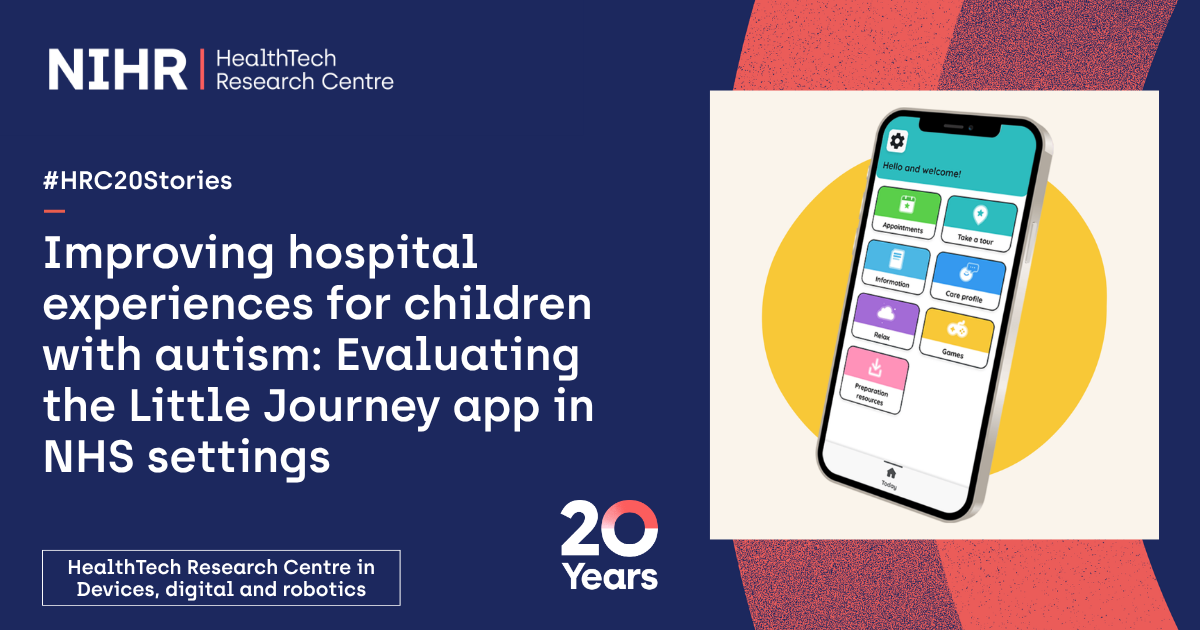
To address this, Little Journey Ltd developed a child-friendly digital app designed to prepare children and families for hospital visits. The app helps children understand what to expect, while enabling clinicians to better tailor care through insights into patient needs, anxiety levels and previous experiences.
The NIHR Health Tech Research Centre in Devices, Digital and Robotics (HRC-DDR) collaborated with Little Journey Ltd and the NIHR Clinical Research Facility at Birmingham Children’s Hospital to evaluate the app’s usability and acceptability among children with ASD and their families. The team actively worked to bring together clinical expertise, patient insight and industry collaboration to generate evidence for real-world use.
Findings showed that the app is engaging, easy to use, and meets an important unmet need. Feedback from participants directly informed further development, leading to enhancements in functionality and accessibility.
The app is now in active use and continues to be evaluated in clinical settings, with emerging evidence suggesting benefits for both patient experience and healthcare delivery.
Clear purpose and why
Children with ASD often face significant challenges when attending hospital appointments, which can lead to distress for both the child and their family, as well as difficulties for healthcare professionals delivering care. Traditional preparation methods are not always accessible or effective for neurodivergent children, creating a gap in support.
This project evaluated whether a digital preparation tool could improve the hospital experience by reducing anxiety, supporting communication and enabling more personalised care. It also sought to understand how such a tool could be used in practice by families and healthcare professionals and whether it could support more efficient and effective care delivery.
Improving this experience is important not only for patient wellbeing, but also for supporting more inclusive healthcare environments and better use of clinical time.
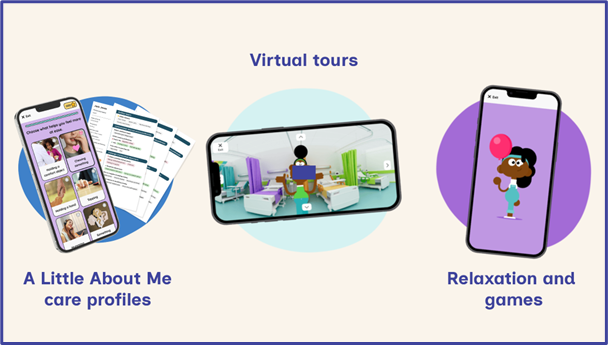
Screenshots of how the Little Journey app works.
Approach
The NIHR HRC-DDR supports the development and evaluation of health technologies by connecting innovators with NHS services, researchers, and patients. Its role is to generate the evidence needed to ensure technologies are safe, effective, and suitable for real-world use.
To assess the usability and acceptability of the Little Journey app, the NIHR HRC-DDR partnered with the NIHR Clinical Research Facility at Birmingham Children’s Hospital and Little Journey Ltd to conduct a structured usability study.
The study involved children aged 3 to 12 years with a diagnosis of ASD, along with their parents or carers. They were recruited through Birmingham Children’s Hospital and invited to test the app in a quiet, controlled environment designed to reflect how it would typically be used.
Families were asked to complete a series of guided tasks within the app, followed by semi-structured interviews to explore their experiences in more depth. This approach enabled researchers to capture both practical usability insights and more detailed feedback on how the app supported understanding, engagement, and emotional preparation.
The findings were shared directly with Little Journey Ltd, allowing for rapid iteration and improvement of the app’s features.
Insights and impact
Through this work, the HRC enabled early-stage user feedback to directly shape product development, reducing risk and accelerating the pathway toward clinical adoption.
Feedback from both children and parents was consistently positive. Children described the app as easy to use, engaging and enjoyable, with features such as hospital tours and quizzes helping them understand what to expect. Parents highlighted the app’s ability to reduce anxiety and support their child in preparing for hospital visits in a way that felt accessible and reassuring.
Importantly, the app also supported better communication between families and healthcare professionals. By capturing information about a child’s preferences, needs and concerns, it enables more personalised care and helps clinical teams prepare in advance.
Participant feedback directly influenced improvements to the app, including the introduction of more interactive features, enhanced visuals, additional language options and improved usability within key functions. These changes have helped to make the app more inclusive and adaptable to a wider range of users.
Further evaluation in clinical settings has demonstrated benefits for healthcare professionals. Staff reported high levels of satisfaction and indicated that children and families arrived better prepared for appointments. This, in turn, supported more efficient use of clinical time and smoother delivery of care.
An exploratory return on investment analysis estimated a £26.20 return for every £1 invested at the individual healthcare professional level, with potential for greater savings when implemented at scale. These findings suggest that digital preparation tools such as the Little Journey app can deliver both patient and system-level benefits.
Overall, this work demonstrates how a simple, well-designed digital tool can improve the hospital experience for children with ASD, while supporting more responsive and efficient care.
The wider impact of Little Journey has also been demonstrated in real-world healthcare challenges. During the COVID-19 pandemic, the platform was used in partnership with NHS organisations and national bodies to develop child-friendly educational content explaining testing and vaccination. This work reached over 500,000 children and families, with high engagement and significantly increased watch times compared to standard content.
This demonstrates the adaptability and scalability of the approach, showing how digital tools developed through HRC-supported collaboration can be rapidly deployed to meet emerging healthcare needs while continuing to support patient understanding and reduce anxiety.
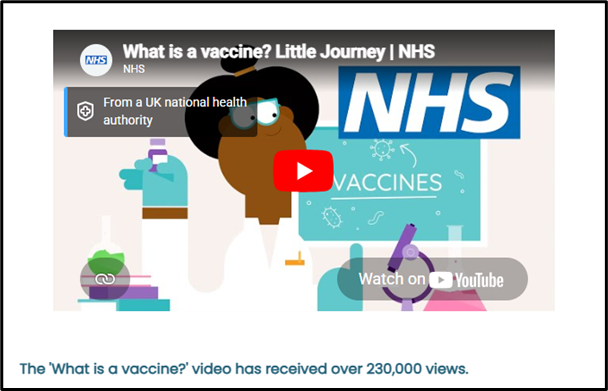
What is a vaccine? Little Journey | NHS.
Reflections
This collaboration highlights the importance of involving patients and families in the development and evaluation of digital health technologies. Testing the app in realistic settings ensured that feedback was grounded in real-world use, leading to meaningful and practical improvements.
It also demonstrates the role of the HRC as a bridge between innovators, the NHS, and patients, supporting technologies to move from concept to real-world application. This enabled rapid feedback loops and ensured that the technology evolved in line with both user needs and clinical priorities.
Future research could build on these findings by evaluating the app in larger and more diverse patient populations, as well as across different clinical settings. There is also an opportunity to explore how digital preparation tools can be integrated more fully into care pathways and scaled across healthcare systems.
Alongside this, Little Journey has expanded its offer through a free CPD-accredited training programme for healthcare professionals. Developed as part of the LEGO Foundation’s Play for All Accelerator, this programme combines research evidence, clinical expertise, and lived experience to support more inclusive care for neurodivergent children.
By equipping healthcare professionals with the knowledge and confidence to respond to diverse patient needs, this work extends beyond a single innovation and contributes to wider cultural change within healthcare. The ultimate aim is to create environments where children feel understood, families feel supported, and clinicians are able to deliver personalised care with confidence.
Affiliations and links
This project was delivered through a collaboration between the NIHR Health Tech Research Centre in Devices, Digital and Robotics (HRC-DDR), the NIHR Clinical Research Facility at Birmingham Children’s Hospital, and Little Journey Ltd.
Birmingham Children’s Hospital played a key role in supporting study design, participant recruitment, and delivery of the usability study within a clinical context. Little Journey Ltd led the development of the app and incorporated user feedback into ongoing product improvements.
The work forms part of the NIHR’s broader mission to support the development and adoption of health technologies that improve patient outcomes and experience. It also aligns with wider collaborations across healthcare, academia, and industry to advance inclusive and patient-centred innovation.