

Patient and Public Involvement and Engagement (PPIE) & Research Inclusion (RI)
We are championing using patient, public and community voices to shape, direct and create health technology research via patient and public involvement and engagement (PPIE). The National Institute for Health and Care Research (NIHR) defines PPIE as research being carried out ‘with’ or ‘by’ members of the public rather than ‘to’, ‘about’ or ‘for’ them.
When the public gets involved in research (involvement), they work alongside researchers to help shape:
- What research gets done.
- How it is carried out.
- How the results are shared and applied in practice.
We also want to make sure that information is shared with the public to improve knowledge, increase transparency and maintain accountability. This is known as patient engagement. Engagement is a two-way process, involving interaction and listening, with the goal of generating mutual benefit.
When we use the term ‘public’ in this context, we are including:
- Patients and potential patients.
- Carers and people who use health and social care services.
- People from organisations that represent people who use services.
- Members of communities across the UK.
Research inclusion
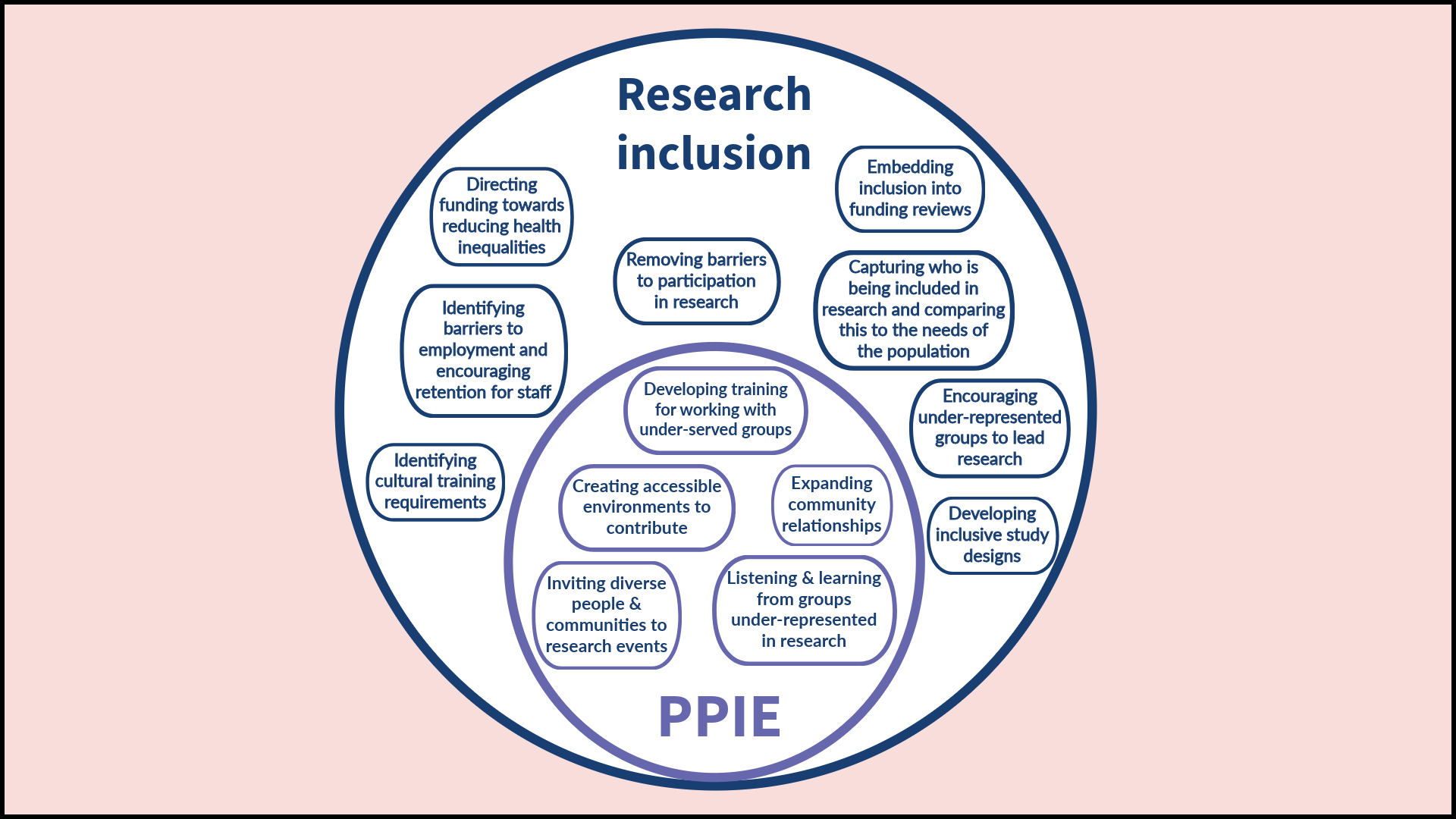
Alongside PPIE, we are developing practices to make research fairer and more representative. NIHR uses the term 'research inclusion' (RI) to describe the mission of addressing inequalities related to various groups. The key is improving the nation's health and wealth through research. This means considering inclusivity practices across the whole research process.
Inclusivity is an approach to ensure that individuals with different backgrounds and needs are welcomed, culturally and socially, fostering a sense of belonging with their needs considered and promoted.
The goal of RI is to ensure that health and social care research includes participants from all regions and communities, meeting the needs of the whole population, reducing health inequalities and improving the health of everyone. .
This can be in relation to participation in research studies, as well as those involved in involvement and engagement activities. RI also considers who works in or reviews research. It aims to support individuals with diverse backgrounds, as well ensuring everyone is trained for understanding different needs. The below diagram shows how our Network is supporting RI as part and in addition to PPIE.
The PPIE & RI HRC Network Workstream
PPIE and RI are vital for developing new health technologies. They ensure that our innovations are firmly grounded in lived experiences. For our Network, this work is about creating a national framework that can deliver the scale and diversity required to effectively tackle national health inequalities.
We are led by the NIHR HRC in Diagnostic and Technology Evaluation, with support from the NIHR HRC in Brain Health and the NIHR HRC in Rehabilitation. The workstream is coordinated by Alessia Dunn - Project manager for Involvement & Inclusion.
Our approach - strategy
Our approach is to make sure our work addresses the most important health needs across the country. We actively look for what is needed, working with national partners like James Lind Alliance (JLA), NHS England, and community groups to ensure all our collective efforts focus on the most critical and strategic areas.
This work is broken into two main areas:
 Read our Patient and Public Involvement and Engagement Strategy
Read our Research Inclusion Strategy
Ways to get involved
We are running a patient and public advisory group (PAG), to make sure that voices are represented at decision making stages in the Network. We are currently in the process of developing this with a pilot group which will finish in September 2026.
We also want to connect with individuals of all areas to increase our reach and hear from voices. If you are interested in health technology development or being part of an advisory group after this date, please fill out our contact form.

Resources and events
We are in the process of developing a suite of resources to promote PPIE and RI for health technology. To explore more about this topic today, explore the links below.
For any specific events relating to PPIE and RI, we will post these on our events page. If you have training, events or resources you’d like to promote, please get in touch via our contact form.