


Working groups are central to achieving the ambition of the Healthtech Research Centre (HRC) Network, serving as the engine rooms for national collaboration that connect expertise, resources, and ideas across the Network.
Managing distinct working groups across the HealthTech landscape to support alignment with NIHR, DHSC and national strategies is no small feat, especially when you’re bridging fields as technically dense as Data and AI, as clinically broad as Paediatrics and Child Health and as human-centred as QUBIS (Qualitative, Human Factors, Implementation Science, Usability and Behavioural Science).
Healthcare challenges are too complex for any single HRC to address in isolation. The goal is to move the 14 HRCs from silos to a unified HealthTech front and in the world of clinical innovation, brilliant ideas often stall because they lack a holistic ecosystem. By coordinating working groups, we ensure that no HRC operates in a vacuum and turn a collection of individual experts into formidable resources. Different experts and HRCs are able to offer various perspectives on best practices, identify and discuss common challenges and barriers to research, initiate collaborative projects to improve methodologies and research, and provide internal and stakeholder training where appropriate.
Additionally, the working groups connect with external expertise as required. For instance, involving NICE or MHRA in workshops to ensure new evaluation methodologies developed by the groups are relevant or address regulatory needs and standards for the purposes of certification where relevant.
The working groups operate in two divisions, the methodology and the cross-cutting hub.
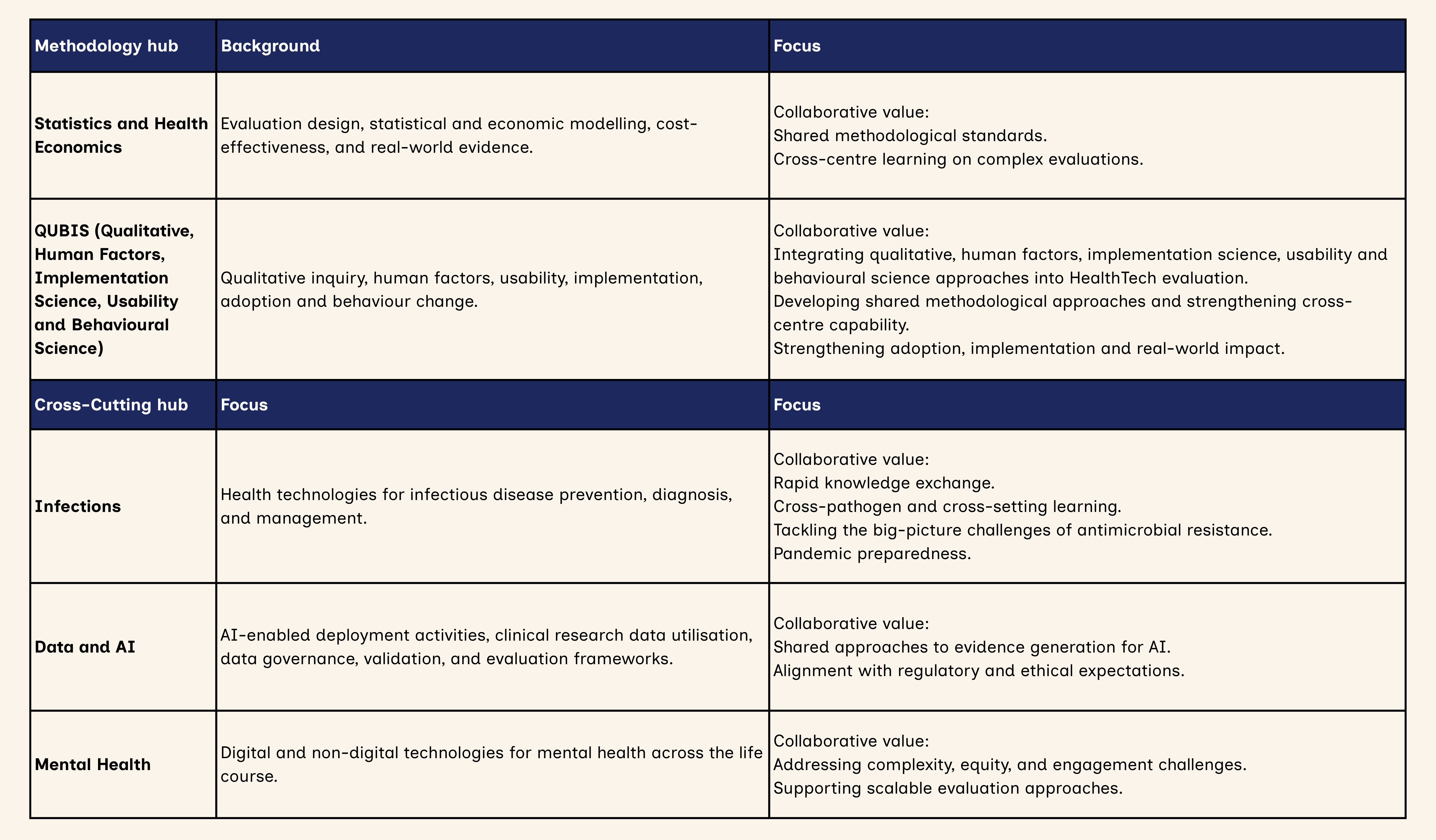
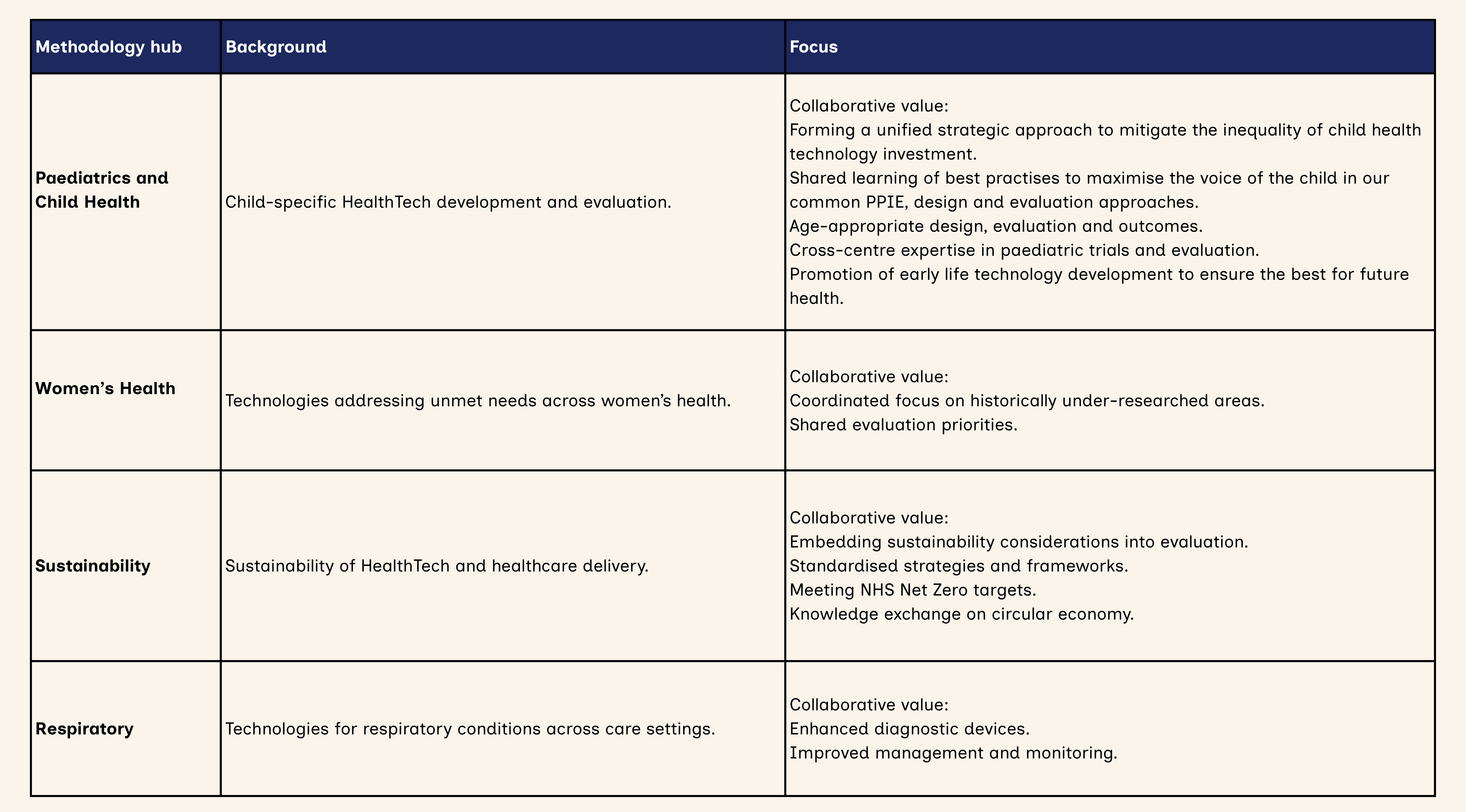
Outputs from fostering collaboration
By bringing together clinical, methodological, and technological expertise, the groups support the development of robust, scalable HealthTech and accelerate the evaluation and subsequent translation of innovation into practice.
Knowledge exchange
Regular cross meetings enable shared challenges, lessons learned and identified best practices. Reduced duplication of activities streamlining delivery.
Industry events and engagement
Facilitating industry events and engagement activities to foster partnerships, share priorities, and identify collaboration opportunities.
Standardisation
Developing unified frameworks reducing duplication and variation across research activities.
Joint bids and pathways
Creating collaborative projects and pathways to strengthen methodologies, enhance research and accelerate innovation.
Capacity building
Hosting workshops, seminars, and cross-training initiatives.
Policy and regulatory engagement
Providing coordinated responses and expert insights to policy-makers.
Current key achievements and updates
Statistics and Health Economics
-
Cross-NIHR collaboration with Imperial RSS on RSS National Methodology Fund.
-
Joint Methodology Theme Launch involving external stakeholders (NICE, Roche, UCL).
-
Identification of priority methodology topics.
-
Hosted an online seminar for group members to share methodological knowledge.
QUBIS
-
Secured £49,637 in internal funding for 'Accelerating Translation through a Cross-HRC Implementation Preparedness Toolkit for Early-Stage Health Technologies'.
-
Commenced project delivery, with the first phase now underway.
-
Delivered the joint Methodology Theme launch, involving external stakeholders from NICE, Roche and UCL.
-
Established a monthly project spotlight series to share methodological expertise, projects and learning across the HRC Network.
Data and AI
-
Joined the MHRA AI Airlock Programme Committee of Experts to identify and address the challenges regarding the regulation of AI as a medical device (AIaMD).
-
HRCs data needs and assessment survey launched.
Infections
-
Secured £49,829.42 in internal funding for 'Achieving impactful behaviour change in the diagnosis of acute respiratory infection in hospital-based care, with a focus on the Emergency Department’: Understanding the perceived mismatch between diagnostic test result and clinical syndrome in clinical decision making.
-
Hosted a UTI Diagnostic Innovation Workshop with Multidisciplinary Feedback Clinics for SMEs.
-
Engaging with NHSE AMR Diagnostic programme to support decisions around pilots and funding.
-
Secured 2 collaborative bids with companies including multiple members of the working group.
Paediatrics
-
Inaugural Launch Workshop involving external stakeholders (HIN, Children’s Hospital Alliance, Alder Hey Innovation, National Centre for Child Health Technology).
-
Informing an NIHR i4i FAST call priority area and scale up opportunities for “Healthier Together”.
-
Inputs for industry survey to better understand the factors limiting the engagement in paediatric health technology development.
-
Economic position: Explore NHS Resolution and medico-legal data to demonstrate paediatrics as a top area of investment/saving opportunity.
-
Communications Strategy: Explore the possibility of developing and sharing best practice guides tailored for different audiences (industry, healthcare professionals, and academics), and launch a "mythbusting" initiative to address common misconceptions about paediatric HealthTech barriers.
Mental Health
-
Investigating the barriers/benefits of mental health technology adoption using PPIE and expert engagement.
-
Interaction with Industrial partners.
Sustainability
-
Standardisation of key sustainable strategies across HRCs, working towards a national sustainability strategy.
-
Completed Sustainability skills and training audit.
-
Early Engagement Form Refinement.
-
Net Zero (Innovation) Catalyst - CPD accredited programme working across the HRC Network.
-
HRC Sustainability event (September 2026).
-
HRC SUSTAIN Facility at Leeds - aligned with HRC sustainability cross-cutting theme.
Women’s Health
-
Steer from DHSC through the Women’s Health Collaboration Advisory Group on focus areas.
-
Strategic priorities refinement and survey distribution.
-
Investigation and compilation of technologies that may unfairly disadvantage women despite not being specifically targeted at female health.
-
Plans for an industry-focused event to showcase expertise and facilitate relationships with innovators.
Respiratory
-
Shaping the Invention for Innovation (i4i) programme Funding At the Speed of Translation (FAST) call scope before launch.
-
Participating in the i4i launch webinar to introduce the call and explain the clinical context.