

Improving healthcare relies not only on developing new technologies, but also on investing in the people and specialist skills needed to make research happen. Through a project exploring how depression is diagnosed, the NIHR HealthTech Research Centre: Diagnostic and Technology Evaluation (HRC DTE) has helped support the development of PhD researcher Jay Hall, whose work brings together clinical expertise and the experiences of people living with depression.
Initially supported through a £120,000 award from the DHSC Mental Health Research Initiative, in 2021, the research developed into a PhD studentship funded collaboratively by three NIHR infrastructures: HRC DTE, Newcastle Biomedical Research Centre (BRC) and NIHR Applied Research Collaboration for the North East and North Cumbria (ARC NENC) which began in Autumn 2022.
Through this investment, Jay has developed expertise in qualitative research, care pathway analysis and mental health research. Her work has generated insights into how depression is diagnosed and where improvements could help make the process clearer, more consistent and timely for patients.
Why is this work important?
Around one in six people in the UK experience depression, which can have a significant impact on their quality of life. Despite its prevalence, reaching a diagnosis is not always straightforward. People may encounter challenges navigating different parts of the healthcare system, while clinicians must make decisions within complex and often time-pressured environments.
Understanding these challenges requires looking beyond individual appointments or diagnostic tools. It means considering the whole care pathway, from a person's first presentation in primary care through to specialist assessment, referral and ongoing support.
Jay’s research also addresses an important need for better evidence to inform the development and use of diagnostic approaches. By exploring the perspectives of both healthcare professionals and people with lived experience, the project aims to identify where the current pathway could work better and how patients might receive more timely and appropriate support.

After studying Biomedical Sciences at Newcastle University, Jay joined the HRC team as a Neuroscience MRes student in 2022.
How is the NIHR HRC: Diagnostic and Technology Evaluation helping to tackle this challenge?
The HRC initially secured £120,000 through the DHSC Mental Health Research Initiative to examine the process of diagnosing depression and bipolar disorder. The project began with Jay’s research during her Neuroscience Master's degree at Newcastle University in 2022, before expanding into a PhD studentship via the secured funding.
The PhD is jointly funded by three NIHR infrastructures: HRC DTE, Newcastle BRC and NIHR ARC NENC. This collaboration has enabled the project to draw on expertise across different areas of research and provided dedicated support for Jay's development as an early-career researcher.
Importantly, this investment has supported more than the delivery of an individual research project. Jay has developed specialist skills in qualitative methods, mental health research and care pathway analysis, building on her original background in biomedical sciences. During this time, she has also completed a Master's conversion degree in Psychology, further strengthening her understanding of psychiatric conditions.
Her development has continued beyond the PhD itself. Since August 2025, Jay has also worked as a Mixed Methods Technical Analyst within the HRC DTE team, applying her expertise in qualitative research and care pathway analysis to other projects and supporting the generation of evidence for new diagnostics.
What progress has the project made to date, and what outcomes have been achieved?
The research has combined a review of existing evidence with interviews to understand the diagnostic pathway from different perspectives.
The team completed a scoping review examining the diagnostic accuracy of screening tools and rating scales for depression. They also interviewed 32 people: 10 GPs, 11 psychiatrists working across secondary and tertiary care, and 11 people with lived experience of receiving a depression diagnosis.
By bringing these perspectives together, the research has helped build a broader picture of the challenges experienced across the pathway. The interviews highlighted the importance of the relationship between patients and GPs, time pressures within consultations, and the complexity of depressive symptoms, particularly where other health conditions overlap.
The findings are now contributing to the wider evidence base around mental health diagnosis. In July 2026, Jay and colleagues published a qualitative study exploring GPs' perspectives on the challenges of diagnosing depression. Interviews with 10 GPs identified three key areas: the complexity of how depression presents, constraints around time and access to services, and the importance of continuity of care.
The research has also been shared through conference presentations, including the NIHR Mental Health Research Initiative Symposium and the North East Postgraduate Conference, helping bring its findings to wider research and clinical audiences.
Alongside the research outputs, the project has strengthened the HRC team's expertise in mental health research and qualitative methods, creating skills and experience that can support future studies and diagnostic evaluation work.
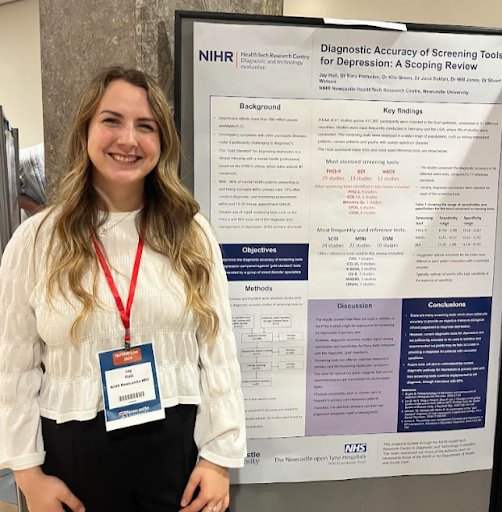
Jay presented her findings at NUTCRI Live 2024, hosted by the Newcastle University Translational and Clinical Research Institute.
What has the HRC learned, and where do we go from here?
This project demonstrates the value of investing in research talent as part of building long-term capacity across the health and care research system.
Supporting a PhD studentship has enabled Jay to develop expertise in an area that complements the HRC's wider work, while providing opportunities to apply those skills beyond her own research. Her progression from Masters researcher to PhD student and Mixed Methods Technical Analyst illustrates how research infrastructure can help develop and retain specialist skills within the research workforce.
Jay said:
“The support of the NIHR, through the BRC, ARC and HRC DTE teams, has given me the opportunity to grow as a researcher and explore the challenges involved in diagnosing depression. Interviews with patients and clinicians have shown me how complex the journey to diagnosis can be, and how difficult it can be to access timely, coordinated care that addresses a person’s interconnected needs. I hope that bringing together patient and clinician perspectives can help inform a more responsive and connected approach to depression care."
The project has also highlighted the importance of examining a healthcare pathway from multiple perspectives. Bringing together the experiences of patients, GPs and psychiatrists has helped identify both shared challenges and differences in how the diagnostic process is experienced. The team has recognised that broader and more diverse recruitment, alongside continued public involvement, would strengthen future research further.
Next steps
The next priority is to continue sharing the project's findings and explore how they could inform improvements to depression diagnosis, referral, follow-up and treatment.
The team is also exploring opportunities to build on this work in relation to people living with multiple long-term conditions, an area of focus for HRC DTE. Sharing learning with other NIHR infrastructure working in mental health will be important in supporting further collaboration and identifying opportunities for future research.
Through the HRC Network's mental health working group, there is also potential to connect with colleagues across the wider Network and share insights from the project.
Who helped make this work possible?
The project was initially supported through a £120,000 DHSC Mental Health Research Initiative award and developed into a PhD studentship funded collaboratively by:
-
NIHR HealthTech Research Centre: Diagnostic and Technology Evaluation
-
NIHR Applied Research Collaboration for the North East and North Cumbria
The research was led by PhD student Jay Hall, with contributions from researchers and clinical collaborators at Newcastle University, Keele University and Cumbria, Northumberland, Tyne and Wear NHS Foundation Trust. The HRC's Insight Panel for Patients, Public and Carers also contributed feedback on the study design, patient-facing materials and interview approach.
Together, these partnerships demonstrate how NIHR infrastructure can support both the generation of valuable research evidence and the development of the skilled people needed to deliver future research.