

How does the Involvement & Inclusion workstream work across the HRC Network?
Patient and Public Involvement and Engagement (PPIE) and Research Inclusion (RI) ensure that our scientific advancements remain rooted in real-world human needs. Within the HRC Network, power is devolved to local HRCs and fed back to benefit the wider group. PPIE & RI expertise thrives within individual Health Tech Research Centres (HRCs) while connecting to a broader, nationwide Network. By aligning regional insights to collective national strategy, our federated framework allows us to share wisdom, amplify impact, and ensure that the public voice is central in shaping the future of healthcare technology.
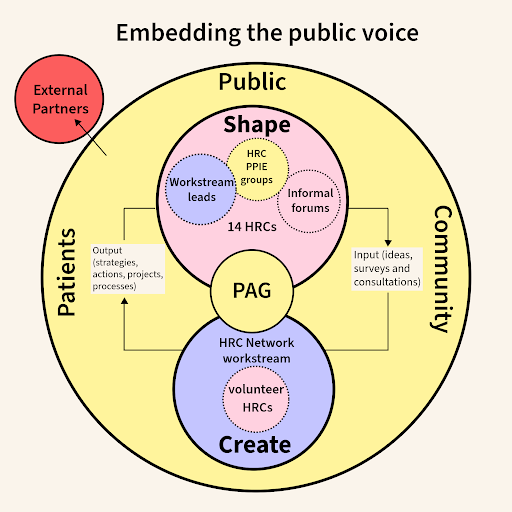
Diagram of how collaboration occurs in the Involvement & Inclusion workstream, making sure that the public are central to all activities.
What are our collaborative approaches for the I&I workstream?
-
Cultivating ideas directly from local communities via HRC PPIE leads.
-
Informal forums for Q&A and troubleshooting, to promote continuous peer learning and support.
-
Feeding local insights into workstream meetings to refine strategy and tactics, map training needs, and co-develop solutions.
-
Aligning the all 14 HRCs to co-create tailored, high-value outputs for HRC members.
-
Building shared online resource repositories to capture and promote methods and best practices across centres.
We then integrate public perspectives via our Public Advisory Group (PAG) to embed patient voices in decision-making across the Network. Through step-change, cyclical methods and developing strong peer relationships, we continue expanding our Network to create and share curated resources for health technology.
How does the I&I Workstream drive impact together?
PPIE is built on collaboration. Across the HRC Network, our PPIE leads are keen to share experiences, learn from one another and bring different perspectives to the table. This exchange of knowledge has created new opportunities to work together and strengthened connections across organisations.
The power of this collective was evident at our recent I&I Away Day. The mandate from participants was clear: we need an open, creative forum to exchange ideas, tackle challenges, and inspire one another. We kicked off the day with a speed-networking session. Staff members connected with colleagues they hadn't met before, exchanging insights on their roles and discovering how different HRCs tailor their involvement and engagement strategies. In just three 8-minute rounds among 15 participants, 45 new connections were made, setting an energising tone for the rest of the day.
We then dove into interactive "Challenges and Solutions", a feature of our informal monthly drop-in sessions. These regular monthly catch-ups offer a supportive, low-pressure environment where team members can bring ongoing hurdles or celebrate milestone successes, providing mutual insight into the rapidly evolving HealthTechlandscape. These casual spaces allow us to listen closely to what is happening at the grassroots level and surface fresh topics organically.
During our Away Day, PPIE leads identified areas where they felt confident and where they wanted to develop further. We used this to bring colleagues together in mentoring groups, creating opportunities to share practical experience, exchange resources and learn from one another. The openness and generosity shown really demonstrated the collaborative spirit of our workstream.
Through collective group debriefs, we co-created practical solutions to real-world problems and pinpointed shared areas where we needed broader support. This direct reflection helped feed into a skills assessment to clearly map out what each HRC hopes to explore next.
The findings from the skills assessment were interesting: while individual HRCs are leading initiatives with confidence, there remains a collective determination to keep learning from each other and to discover fresh, innovative ways to elevate our work.
A top priority identified was the desire for novel facilitation techniques. While our PPIE leads bring valuable experience and expertise, exploring new and creative approaches helps us keep our sessions engaging and make the most of our public contributors' involvement. Additionally, team members expressed interest in targeted development around involvement costing, public contributor management, and navigating complex participation dynamics.
This user-led feedback loop ensures our workstream stays directly responsive to the real needs of our HRC leads, translating frontline challenges into actionable solution strategies.
Feeding ideas to the federated leadership
Comprising leadership from the NIHR HRC; Diagnostics and Technology Evaluation (DTE), Rehabilitation, and Brain Health (BH), our core workstream meets every other month to steer initiatives emerging across all workstream levels. We design interactive discussion sessions for our larger quarterly HRC meetings, curate Network-wide training materials, and refine collaborative outputs before releasing them to the wider community.
Since November 2025, our workstream has explored a range of important themes, from industry engagement training and demographic data collection to research inclusion and fair approaches to reward and recognition. This focused agenda gives us clear direction, ensuring that every tool and resource we produce meets the needs of the vast majority of our HRC members. Alongside structured planning, our informal monthly catch-ups offer a safe, agenda-free environment for open dialogue.
To maintain ongoing momentum, these conversations can continue digitally within our collaborative intranet, hosted on NHS Futures. Here, resources, templates, and best practices are shared directly across the Network, steadily building a rich repository of community knowledge. We continue to work closely with the group to refine this so it works seamlessly for everyone.
We also acknowledge a common reality in PPIE work: while teams are eager to share, polishing every document to perfection can feel daunting when guidance evolves and capacity is tight.
Fostering an environment where draft ideas can be shared openly and refined together requires deep mutual trust. Building this trust lies at the heart of the workstream’s collaborative approach. Equally important is making contributions visible, recognising the time, expertise and commitment that teams bring to collaborative work. Through spotlight profiles and public acknowledgments across the HRC Network, we celebrate individual and team contributions - helping shine a deserving light on their local achievements.
Looking ahead to the future of the I&I workstream
Looking ahead, the I&I workstream is excited to expand this collaborative model through our upcoming Impact and Community Framework. This framework will establish clear quality-assurance processes while honoring the deep, trusting relationships that make our PPIE leads so effective. We also want to share the work conducted by the PPIE Leads alongside public contributors at the Involvement & Inclusion Showcase scheduled for March 2027 (further details to follow).
Our joint efforts have already gained national visibility, featured in posters and presentations at major events such as the NIHR Innovation Observatory and Research & Development Forum conferences, as well as a published blog about harnessing national expertise to accelerate widespread HealthTech adoption. As the HRC Network continues to grow, so will our collective reach and influence.
Beyond supporting internal teams, our PPIE Leads serve as dedicated advocates for public contributors across the Network. We are actively expanding the public voice within our strategy to ensure patient perspectives are interwoven through everything we do. Achieving true impact requires reciprocal learning at the public level, especially when seeking insights from diverse, nationwide communities. By bringing together public voices across all 14 HRCs, we stand the best chance of listening to and serving the full diversity of our population.
Embedding the public voice at every level
Our Public Advisory Group (PAG) is expanding, bringing new opportunities for public contributors to get involved at the national level. Involvement may be practical co-design, collaborating on network activities and creating shared resources together. Additionally the PAG provides strategic guidance, leveraging lived experiences with health technologies to advocate for public needs and bring important questions directly to decision-makers across the healthcare ecosystem.
Through our PPIE leads and expanded PAG, we are building a trusted, resilient network of expertise. Together, we are transforming engagement from a series of isolated efforts into a unified, national movement that puts patients and the public at the center of health technology innovation.
Working across 14 distinct centres, our strength comes from our willingness to break down silos and collaborate meaningfully. Through monthly drop-in sessions, creative away days, and continuous dialogue on NHS Futures, our Leads do more than just manage projects, they mentor each other, share raw ideas, and build trust. By embracing collaborative approaches and working transparently, we've created an environment where people feel empowered to share ideas, challenge thinking and explore new possibilities.