


Sheffield is playing a leading role in transforming care for people living with chronic illness, as highlighted in the Shaped in Sheffield campaign led by UK Research and Innovation.
At the heart of this impact is the HealthTech Research Centre in Long-term conditions (Devices for Dignity), based at Sheffield Teaching Hospitals NHS Foundation Trust who act as a catalyst for the development of innovative medical devices, healthcare technologies and technology-dependent interventions.
With the campaign launching across the city earlier this week, UKRI Chief Executive Professor Sir Ian Chapman said: “Sheffield is a hotbed of innovation, from its two great universities to its many spin-outs, startups and other businesses. That’s why we’ve chosen to highlight the amazing work shaped by the city and its people.”
Part of the NIHR HealthTech Research Centre (HRC) Network
The Sheffield-based HRC is one of 14 specialist centres within our Network. Our national federated approach unites and leverages the trusted expertise, impact, and influence of all HRCs to transform healthcare innovation so that evidence-based, innovative technologies reach the NHS sooner.
By working closely with NHS partners and Integrated Care Systems, the HRC in Long-term conditions (Devices for Dignity) ensures research is aligned to real service pressures - from reducing avoidable hospital admissions to supporting earlier discharge and rehabilitation closer to home. A strong focus on prevention, recovery and reducing health inequalities underpins all activity.
S-Press: Rehbilitation innovation in action
The S-Press was created by Sheffield physiotherapist Jennifer Turner, drawing on more than 22 years of experience in NHS rehabilitation.
Throughout her career, she worked extensively with older patients transferred from acute wards, many of whom were left profoundly weakened by illness and extended bed rest.
Deconditioning can lead to loss of independence, increased falls and delayed recovery, particularly for people with multiple long-term conditions. Evaluated through Sheffield’s research and clinical partnerships, including collaboration with the Advanced Wellbeing Research Centre, the S-Press supports early leg muscle strength recovery, which impacts mobilisation and functional recovery by allowing any patient to use the device, from their bed or chair, much earlier in their rehab pathway.
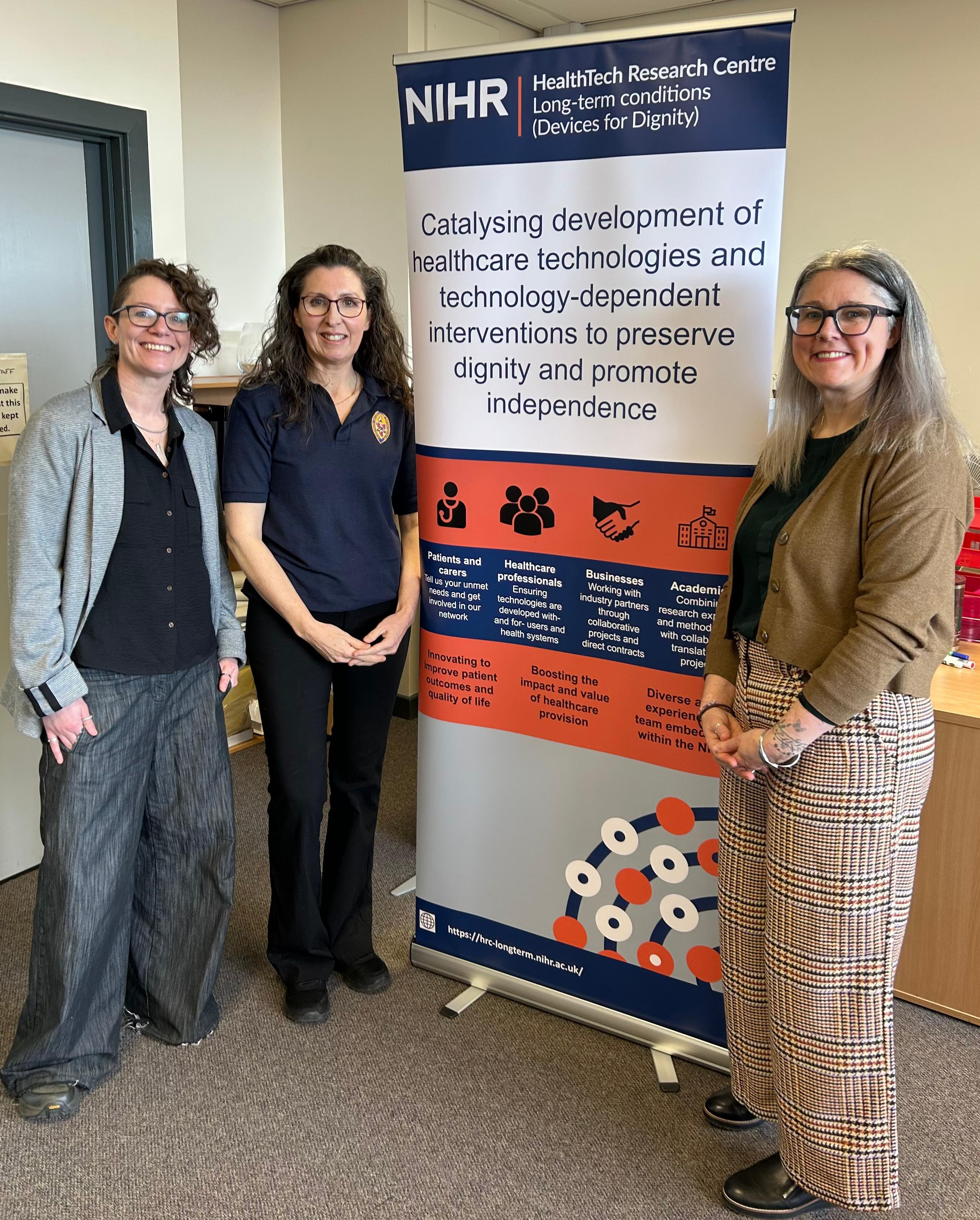
From left to right: Hayley Morris, Deputy Head of Operations: NIHR HRC in Long term conditions (Devices for Dignity), Jennifer Turner: JT Rehab, Liz Pryde, Head of Operations: NIHR HRC in Long term conditions (Devices for Dignity).
How Devices for Dignity supported S-Press
The NIHR HealthTech Research Centre in Long-term conditions (Devices for Dignity) provided targeted, hands-on support to shape the development and early validation of S-Press. This included convening a multidisciplinary “Dragon’s Den” style panel of healthcare professionals to review and provide feedback on early prototypes, alongside supporting a successful funding application to CAHPRA. Through this funding, the team facilitated connections with clinical experts in infection control and tissue viability at Sheffield Teaching Hospitals NHS Foundation Trust, ensuring the device was informed by real-world clinical requirements from an early stage.
The HRC also supported early market and user insight generation. This included co-developing a physiotherapy questionnaire and undertaking qualitative interviews with care home staff and residents, as well as patients and clinicians within an inpatient stroke rehabilitation setting. In parallel, the team linked the innovator with clinical engineering expertise to support development of the technical file, CE marking preparation, and additional funding applications. This package of support helped strengthen the device’s clinical relevance, usability, and pathway towards adoption.
Additional sources
This article draws on material published by UK Research and Innovation and Sheffield Hallam University as part of the Shaped in Sheffield campaign (2026). Discover other innovations as part of this campaign.
To learn more about the HRC in Long term conditions (Devices for Dignity), click here. To learn more about S-Press and see it in action, click here.