

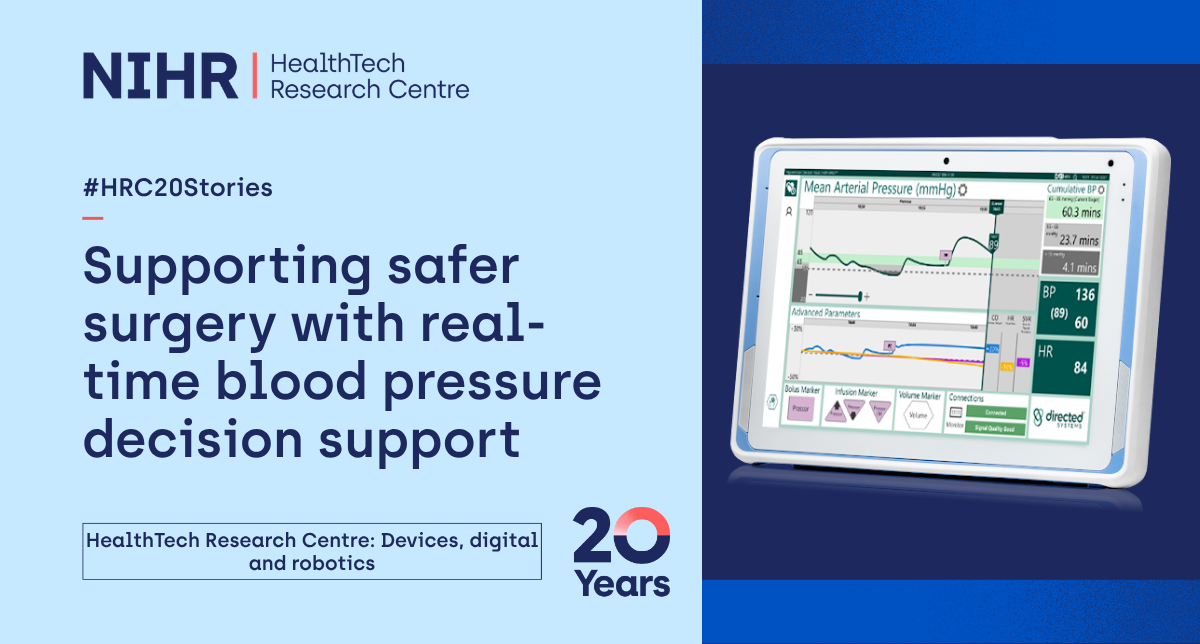
Low blood pressure during surgery is common and can increase the risk of complications following an operation. While anaesthetists continuously monitor patients and use their clinical expertise to manage changes in blood pressure, additional information could help them identify developing episodes of low blood pressure and respond earlier.
Directed Systems Ltd has developed DS Aware, software designed to provide anaesthetists with real-time information about a patient's cardiovascular state during surgery, helping them recognise changes in blood pressure and make informed decisions about treatment.
The NIHR HealthTech Research Centre: Devices, Digital and Robotics (HRC-DDR) has worked with Directed Systems Ltd for almost five years, supporting the development and evaluation of the technology. This has included securing funding, patient and public involvement and engagement (PPIE), usability testing with NHS anaesthetists, regulatory support and a first-in-human clinical evaluation.
More recently, the HRC-DDR collaborated with Directed Systems Ltd as a co-applicant on a successful NIHR Invention for Innovation (i4i) Connect award. This supported the final development of DS Aware for the UK and European markets and enabled the team to generate evidence needed to support applications for UKCA and CE market approval.
Why is this work important?
Maintaining a patient's blood pressure during an operation is an important part of anaesthetic care. A significant drop in blood pressure, known as intraoperative hypotension (IOH), can affect blood flow to vital organs and is associated with complications after surgery.
IOH is common, with UK observational studies suggesting that a majority of older surgical patients experience at least one episode of low blood pressure during an operation. Anaesthetists continuously monitor patients and can adjust anaesthesia, fluids and cardiovascular medication to manage changes, but gradual changes in blood pressure can be difficult to identify before they develop into a more significant episode.
Additional decision-support tools could help anaesthetists identify changes in blood pressure and support timely decisions about treatment, with the potential to improve patient recovery and reduce pressure on NHS resources.
DS Aware has been developed to provide this additional information in real time, while supporting, rather than replacing, the anaesthetist's clinical judgement.
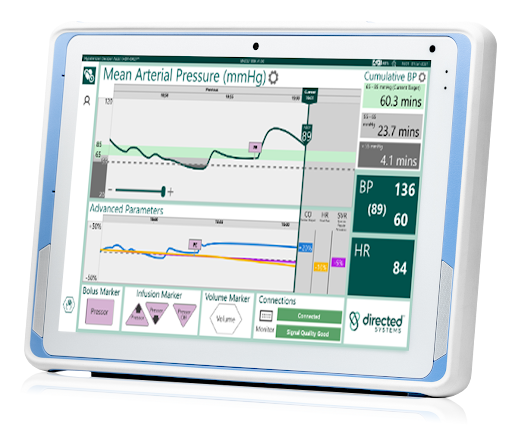
The Directed Systems clinical decision-support interface displays real-time blood pressure data, helping anaesthetists monitor and manage blood pressure during surgery.
How is the NIHR HealthTech Research Centre: Devices, Digital and Robotics helping to tackle this challenge?
The HRC-DDR has supported Directed Systems Ltd throughout several stages of DS Aware's development, building on a long-standing partnership with the company.
Previous collaboration included an Innovate UK-funded project supporting the technology's development and FDA clearance, which subsequently enabled DS Aware to be used in the USA.
The HRC-DDR provided regulatory and commercialisation advice, supported funding applications and conducted human factors and usability studies to assess how the technology could be used safely and effectively by clinicians.
The latest collaboration focused on preparing DS Aware for the UK and European markets. As a co-applicant on the successful NIHR i4i Connect award, the HRC-DDR supported two important areas of evidence generation: understanding whether the technology was acceptable to patients and members of the public, and assessing whether NHS anaesthetists could use the software effectively in a realistic clinical environment.
The HRC-DDR's HealthTech Public Advisory Group helped shape a PPIE survey exploring public views on the risks of post-operative complications, communication from healthcare professionals and the use of patient information and data. The survey was also shared through PPIE groups at the University of Birmingham and across University Hospitals Birmingham NHS Foundation Trust.
Alongside this, the HRC-DDR conducted a usability study at the Medical Devices Testing and Evaluation Centre at University Hospitals Birmingham. Fifteen NHS anaesthetists used DS Aware while managing a simulated patient undergoing emergency abdominal surgery, with the patient simulator demonstrating several episodes of low blood pressure.
This enabled the team to test the software in a realistic setting and gather feedback on its usability, training requirements and supporting materials.
What progress has the project made to date, and what outcomes have been achieved?
The PPIE work provided valuable insight into how patients and the public view technology designed to improve surgical safety. Responses supported the potential role of DS Aware, while highlighting the importance of trust in clinicians and clear communication about how patient information and data are used.
The usability study demonstrated that DS Aware could be used by NHS anaesthetists in a realistic simulated clinical environment. Feedback identified opportunities to improve both the software and the training required to use it, helping Directed Systems Ltd refine the technology.
The findings have contributed to the evidence required by Directed Systems Ltd as it progresses applications for UK and European market approval.
The work builds on an earlier HRC-DDR usability programme, in which clinicians found that the system could provide additional useful information without distracting them from managing the patient. This work helped establish that the technology was ready to progress to clinical investigation.
Together, these activities have helped build the evidence base around DS Aware, bringing together technical development, clinical expertise and public perspectives as the technology progresses towards potential use in the NHS.
What has the HRC learned, and where do we go from here?
The collaboration has demonstrated the value of involving patients, members of the public and clinicians early in the development of digital HealthTech.
For DS Aware, PPIE was not simply an additional stage of the project. It provided insight into what patients would need to understand and trust about a technology being used during their care, particularly around the use of health data and the role of technology alongside clinical decision making.
The usability work also demonstrated the importance of testing technology with the people who will ultimately use it. Working with NHS anaesthetists in a realistic simulated environment allowed the team to identify improvements to the software and training before the technology progresses further towards clinical use.
By bringing together regulatory expertise, clinical knowledge, usability testing, PPIE and access to NHS professionals, the HRC-DDR has helped Directed Systems Ltd generate evidence at several stages of the technology's development.
This type of support offered by HRCs can help HealthTech developers navigate the journey from innovation to evidence generation and, ultimately, potential adoption within the NHS.
Next steps
Directed Systems Ltd is completing its application for market approval in the UK, with approval anticipated in the second half of 2027.
If approved, DS Aware could become available for use in the NHS, providing anaesthetists with additional real-time information to support the management of blood pressure during surgery.
Further clinical evaluation will be important to establish how the technology performs in routine practice and whether its use can translate into improvements in patient outcomes, recovery and NHS resource use.
The HRC-DDR will continue to support the development and evaluation of HealthTech that has the potential to address challenges in surgical care.
Who helped make this work possible?
The project was delivered through a long-standing collaboration between Directed Systems Ltd and the NIHR HRC: Devices, Digital and Robotics, hosted by University Hospitals Birmingham NHS Foundation Trust.
NHS anaesthetists at University Hospitals Birmingham contributed to the usability evaluation, while the HRC-DDR HealthTech Public Advisory Group and wider PPIE groups helped ensure patient and public perspectives were incorporated into the development process.
The work was supported through NIHR infrastructure and the successful NIHR Invention for Innovation (i4i) Connect award.