

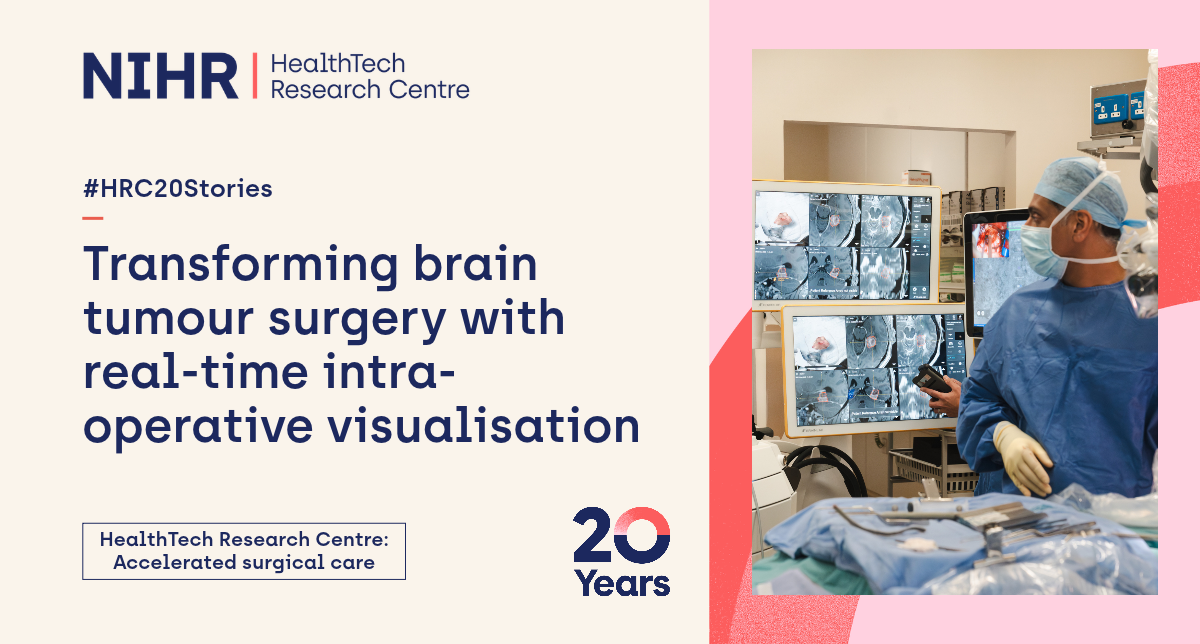
Brain tumour surgery depends on rapid, accurate visualisation to help surgeons remove as much of a tumour as possible while protecting healthy, functioning brain tissue. Traditionally, tissue samples taken during surgery are transported from theatre to a laboratory for analysis; a process that can delay decision-making and sometimes produce inconclusive results. This cumbersome and lengthy process also discourages repeated analysis during a single operation.
To address this challenge, the ZEISS CONVIVO In Vivo Pathology Suite enables neurosurgeons to generate high-quality cellular-resolution images of brain tissue in real time during surgery. This can be used for tumour detection at the margins of resection, and to confirm diagnostic biopsy samples. In-Vivo images can also be reviewed instantly by specialist Neuropathologists remotely, allowing faster clinical decisions during surgery.
The NIHR HealthTech Research Centre: Accelerated Surgical Care (HRC ASC) played a pivotal role in supporting this innovation by assisting the clinical team, securing charitable funding from Leeds Hospitals Charity to purchase the technology, and supporting its implementation into everyday use.
Leeds Teaching Hospitals NHS Trust (LTH) is the first hospital in the UK to introduce the technology into routine care (ZEISS CONVIVO In Vivo Pathology Suite), improving surgical decision-making and creating new opportunities for training and future research.
Why is this work important?
More than 12,000 people are diagnosed with a brain tumour each year in the UK, and achieving the best possible outcomes for patients relies on accurately identifying tumour tissue during an operation.
Historically, surgeons have relied on frozen section (or smear) biopsies (tests used to study tissue while a patient is still under anaesthesia), requiring tissue samples to be removed from the brain and transported to a specialist laboratory for rapid analysis.
This process is time-consuming (20-60 mins depending on laboratory location), can interrupt surgery, and occasionally results in inconclusive findings while the patient is under anaesthetic. It can also discourage additional sampling that may help define tumour margins (the border of healthy tissue surrounding a tumour) more precisely.
The ZEISS CONVIVO tool addresses this challenge by allowing clinicians to visualise brain tissue at tissue microstructure level during surgery, using a handheld confocal laser endomicroscope probe. It also allows for remote analysis of tissue in the brain, which can support healthy tissue preservation.
The HRC ASC supported this innovation by working with the clinical team to evaluate the technology in routine clinical practice and demonstrate its impact on patient care and surgical practice. By providing robust clinical evaluation, the HRC helps showcase the value of innovative technologies and supports their wider adoption across the NHS.
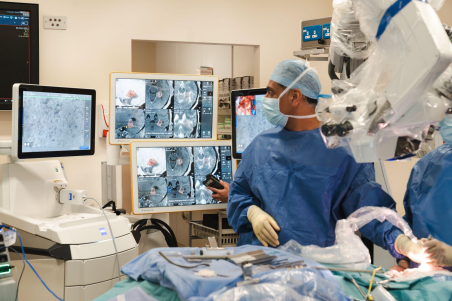
Using the ZEISS CONVIVO Surgical Workplace.
How is the NIHR HealthTech Research Centre: Accelerated Surgical Care helping to tackle this challenge?
The HRC ASC led the clinical evaluation of the ZEISS CONVIVO Surgical Workplace, working alongside Neurosurgeons and Neuropathologists at LTH.
The evaluation focused on validating the technology's ability to produce high-quality microscopic images of tissue cellular structure that can be interpreted in real time during surgery. This allowed Neurosurgeons to progress through a learning curve to distinguish tumour versus non-tumour tissue, and Neuropathologists to assess tumour characteristics to support clinical decision-making; all while surgical procedures were still in progress.
Alongside evaluating diagnostic and detection performance, the Surgical Observatory at the HRC ASC explored how the technology could integrate into existing surgical workflows, ensuring it would be practical for routine NHS use. This involved direct observation of its use in procedures, and comparisons to existing workflows.
The project brought together clinical expertise, research methodology, implementation science and industry innovation to ensure that the technology was optimised for clinical effectiveness.
What progress has the project made to date, and what outcomes have been achieved?
The implementation of the ZEISS CONVIVO at LTH demonstrated that real-time intra-operative visualisation has the potential to transform the way brain tumours are detected during surgery.
Instead of waiting for laboratory analysis, surgeons and neuropathologists can now make decisions using live microscopic images in operating theatres, reducing delays (seconds versus up to an hour) and providing greater confidence when determining how much tumour tissue can safely be removed.
The clinical evaluation provided the evidence required to support adoption at LTH, making it the first hospital in the UK to introduce the technology into routine clinical practice.
The technology also creates valuable opportunities for education and research, enabling trainee neurosurgeons and neuropathologists to learn in real time during procedures.
In the future, the images and data generated by this technology could also support research into the application of Artificial Intelligence (AI) in brain surgery. Although this has not yet been implemented, these datasets may be used to develop and train AI models with the potential to assist with automated tumour detection, diagnosis, and tumour margin analysis.
What has the HRC learned, and where do we go from here?
The impact of this innovation extends across patients, clinicians and the wider NHS.
For patients, faster access to pathology information during surgery supports more informed decision-making, helping surgeons remove as much tumour as possible while preserving healthy brain tissue. This has the potential to improve surgical outcomes and reduce the need for additional procedures.
One patient treated using the technology described the difference it made to her care now that the probe is being used routinely by LTH.
“After the operation, our surgeon told my husband and I about the new technology they had used to perform the surgery, explaining the equipment was charity funded. Prior to surgery it was anticipated that about 70% of the tumour could be removed, but with the help of this technology Neurosurgeons were able to remove over 95% of my tumour; reducing the risk of it growing back.”
The HRC ASC's expertise has enabled this innovation to transition from emerging technology into routine NHS care at LTH, supporting its adoption and implementation and safer, more efficient surgery.
Beyond immediate patient benefits, the technology is expected to strengthen surgical education and provide data for AI training and research, helping shape the future of neurosurgery.
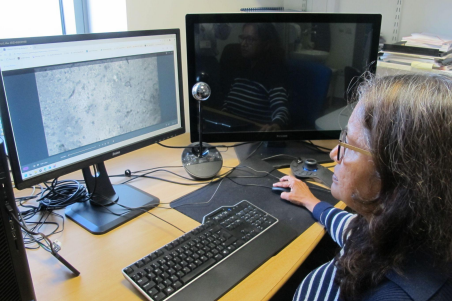
Neuropathologist remotely reviewing images, live-streamed to the ZEISS CONVIVO Pathology Workplace in real-time.
Next steps
The project highlights the value of multidisciplinary collaboration, bringing together surgeons, neuropathologists, researchers and funding from Leeds Hospitals Charity to deliver innovation that directly benefits patients.
As real-time surgical visualisation, digital pathology and AI continue to evolve and converge, technologies such as the ZEISS CONVIVO In-Vivo Pathology Suite have the potential to transform surgical care far beyond brain tumours, improving diagnosis, education and patient outcomes across multiple specialties.
The successful implementation at LTH provides a foundation for wider adoption across the NHS. Leeds has hosted visits from other sites interested in using the technology and clinical teams have presented their data internationally. The HRC ASC will also support hosting of the CONVIVO User Group meeting in 2027.
Future work will continue exploring how the technology can support surgical training, improve clinical decision-making and enable artificial intelligence research using the high-quality imaging data generated during procedures.
The HRC ASC will continue supporting the evaluation of emerging surgical technologies, helping innovators generate the evidence required to bring life-changing innovations into routine patient care.
Who helped make this work possible?
This project was delivered through collaboration between the NIHR HealthTech Research Centre: Accelerated Surgical Care, Leeds Teaching Hospitals NHS Trust (LTH) and Leeds Hospitals Charity, whose £150,000 investment enabled the introduction of the Zeiss CONVIVO Pathology Suite.