

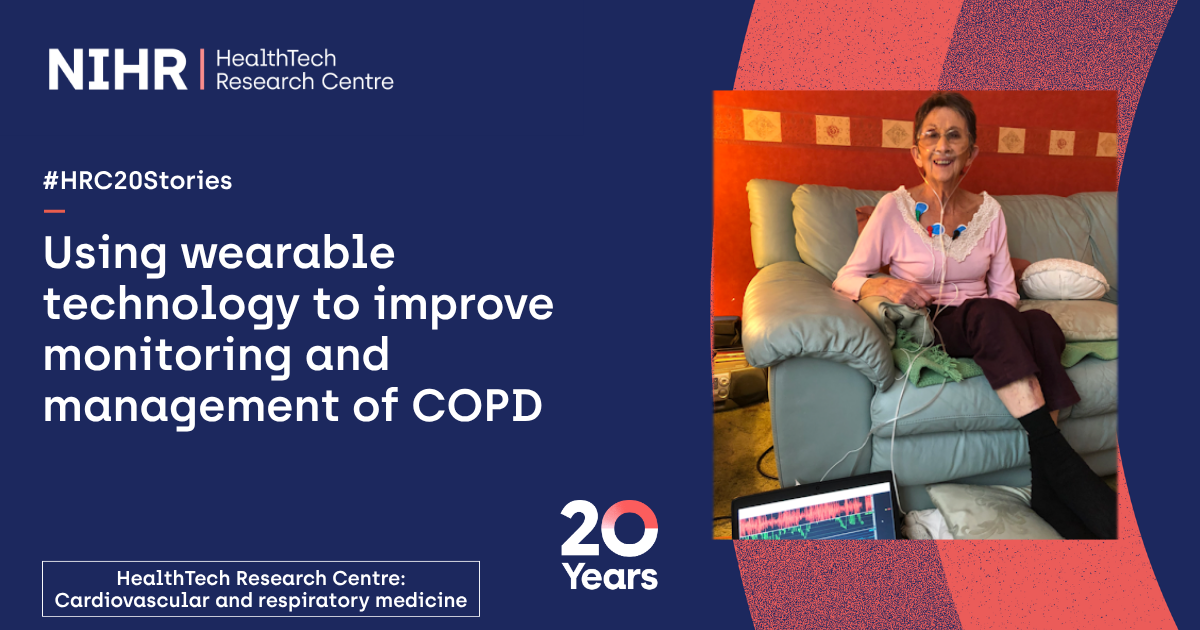
For people with chronic obstructive pulmonary disease (COPD), the period during and after a severe exacerbation (flare up) can be particularly high risk.
Clinicians need to decide whether a patient is improving, and ready to leave hospital, or deteriorating and need enhanced clinical care before discharge from hospital. However, these are challenging clinical decisions with few objective measurements to support decision making for healthcare professionals.
MYOTRACE is a wearable technology designed to address this gap. Described as the ‘respiratory ECG’, it measures neural respiratory drive or ‘drive to breathe’, providing a measure of how hard it is to breathe and how hard the breathing muscles are working. This can help clinicians understand the severity of an exacerbation, track recovery and identify patients at risk of deterioration or readmission.
Developed through more than a decade of research and clinical evaluation, MYOTRACE has progressed from an initial concept and prototype to a clinically validated technology tested across hospital, post discharge, home and primary care settings.
The NIHR HealthTech Research Centre: Cardiovascular and Respiratory Medicine (HRC CRM) is supporting the programme's next phase, working with industry partners to progress licensing and commercialisation and explore how the technology could ultimately be used within routine NHS care.
Prof Nicholas Hart is leading the team behind this initiative. He is Co-Lead of the Advanced Respiratory Monitoring, Imaging and Treatment theme at the HRC CRM and Clinical Director for Research at Guy’s and St Thomas’ NHS Foundation Trust.
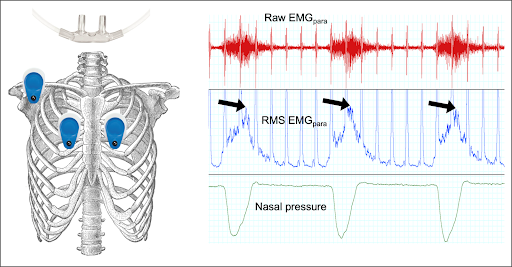
MYOTRACE uses small electrical sensors placed on the chest to measure the electrical activity of the muscles involved in breathing. The system detects and processes these signals to quantify neural respiratory drive: essentially, how strongly the respiratory muscles are being activated with each breath. By measuring this alongside a patient's breathing pattern, MYOTRACE provides a picture of respiratory muscle effort that can be tracked over time.
Why is this work important?
COPD is a major cause of illness and hospitalisation, with almost 120,000 emergency admissions each year in the UK. Following an exacerbation, patients remain at significant risk of returning to hospital, with readmission rates of 15% within 14 days, 20% within 30 days and 40% at 90 days.
During an exacerbation, the breathing drive increases as the muscles have to work much harder to breathe in and out. However, commonly used measures such as oxygen saturation and respiratory rate do not provide a clear picture of this increased breathing effort.
MYOTRACE has been developed to address this gap by measuring neural respiratory drive through a surface measurement taken from the three chest electrodes, similar to an ECG. This provides an objective, real-time indication of the ’drive to breathe’ and the balance between breathing muscle capacity and the high load placed on the breathing muscles.
The ambition is to give clinicians better information to support decisions about treatment, recovery and discharge, while creating the potential to monitor patients beyond the hospital setting.
How is the NIHR HealthTech Research Centre: Cardiovascular and respiratory medicine helping to tackle this challenge?
The MYOTRACE programme has progressed through more than a decade of technical development, prototype testing and clinical evaluation. Early studies investigated whether the technology could identify acute deterioration and support safe discharge during COPD exacerbations. Subsequent work explored automated signal analysis, patient self-measurement, home monitoring, patient-ventilator interaction and treatment response.
The technology has now been evaluated across hospital, post-acute, home and primary care settings, helping to establish its potential use across the COPD care pathway.
The HRC CRM has supported this translational approach by bringing together respiratory physiology, clinical research, technology development, NIHR infrastructure, industry collaboration and patient and public involvement.
The Lane Fox Clinical Respiratory Physiology Respiratory Research Centre's patient and public involvement, engagement and participation group has contributed to the co-design and evaluation of MYOTRACE, helping ensure the technology is developed with patients' experiences and needs in mind.
The HRC CRM is now supporting the programme as it moves towards licensing and commercialisation, helping to build the partnerships and evidence needed to progress from a clinically validated research technology towards potential NHS implementation.
What progress has the project made to date, and what outcomes have been achieved?
Research to date has demonstrated the feasibility and clinical relevance of using MYOTRACE to monitor people with COPD across different stages of their care.
MYOTRACE is helping to address an important gap in respiratory care: monitoring does not necessarily stop when a patient leaves hospital, despite the fact that the period following discharge can remain a high-risk time for people recovering from an acute COPD exacerbation.
Early clinical studies demonstrated that neural respiratory drive measurements could help identify deterioration in hospital and support assessment of safe discharge. More recent research has extended this approach into the home, showing that MYOTRACE can track changes in respiratory physiology alongside patient-reported measures during recovery.
This hospital-to-home approach is an important step towards more continuous respiratory monitoring. Rather than providing a snapshot of a patient’s condition at a single point in their care, MYOTRACE has the potential to follow changes in respiratory health across two critical stages of recovery: during hospital treatment and after returning home.
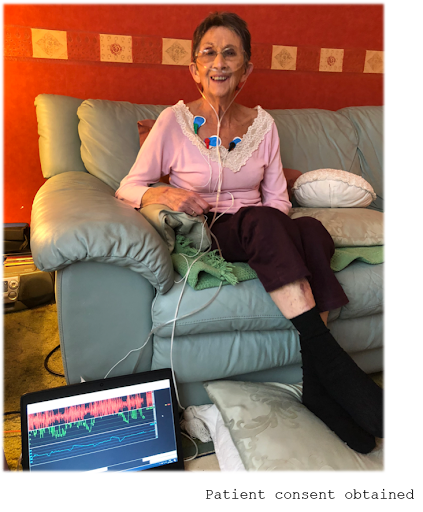
MYOTRACE can be used to monitor respiratory muscle activity both in hospital and at home. Sensors placed on the chest capture electrical signals from the muscles involved in breathing, allowing changes in respiratory physiology to be tracked during recovery following discharge.
MYOTRACE is now being used to provide greater insight into drive to breathe in the NIHR respiratory priority portfolio EPiC-HFT trial, which is investigating whether home high-flow therapy can improve admission-free survival over 12 months following a severe COPD exacerbation.
Together, this work demonstrates the versatility of MYOTRACE and its potential to provide a more continuous picture of respiratory health trajectory across hospital and community settings.
The technology has also secured patent protection in the UK, Europe and US, supporting its progression from research prototype towards commercial development.
What has the NIHR HealthTech Research Centre learned, and where do we go from here?
The MYOTRACE programme demonstrates the value of taking a long-term, translational approach to HealthTech development. Rather than moving directly from prototype to adoption, the programme has used successive technical and clinical studies to understand where the technology can add value and how it can be used in different care settings.
Embedding MYOTRACE within clinical research has also allowed the technology to provide physiological insight into other treatments, demonstrating how a HealthTech innovation can contribute to a wider evidence base rather than operating as a standalone intervention.
The programme highlights the importance of combining physiological research with technology development, clinical evaluation, patient involvement and early consideration of implementation and commercialisation.
For the NHS, the longer-term impact is particularly relevant to the three NHS shifts of analogue to digital, prevention to treatment and hospital to home. A wearable digital technology that can provide objective respiratory health monitoring outside of hospital could support more personalised management of COPD, help clinicians identify deterioration earlier and prevent avoidable readmissions.
Next steps
The next stage of the MYOTRACE programme will focus on licensing and commercialisation of the clinically validated technology, alongside wider engagement with NHS stakeholders to explore implementation and adoption.
Further development will support the transition towards a deployable product, including automated analysis and compatibility with NHS digital infrastructure. The programme identifies a potential UKCA Class IIa regulatory pathway and FHIR/HL7 compatibility to support integration within NHS systems.
The ongoing EPiC-HFT trial will also provide further evidence on the role of MYOTRACE in understanding treatment response during recovery from severe COPD exacerbations.
Who helped make this work possible?
The MYOTRACE programme is led by Professor Nick Hart and colleagues at Guy's and St Thomas' NHS Foundation Trust and King's College London.
The programme brings together the NIHR HealthTech Research Centre in Cardiovascular and Respiratory Medicine, the NIHR South London Regional Research Delivery Network, academic and clinical collaborators, industry partners and patient and public contributors.
The HRC CRM has played a key role in supporting the translation of MYOTRACE towards licensing, commercialisation and potential NHS adoption, alongside its contribution to the programme's clinical and translational research.
HRC: NIHR HealthTech Research Centre in Cardiovascular and Respiratory Medicine
Technology: MYOTRACE
Clinical area: COPD and respiratory disease
Current research: EPiC-HFT
Funding: NIHR-funded research, including an NIHR Doctoral Research Fellowship (DRF-2018-11-ST2-037)