

Tics and Tourette syndrome can have a profound impact on the lives of children and young people, affecting physical health, emotional wellbeing, confidence, education, and social participation. Despite behavioural therapy being recommended as a first-line treatment, access remains extremely limited due to shortages in trained therapists and specialist services.
The Online Remote Behavioural Intervention for Tics (ORBIT) programme was developed to address this unmet need by delivering evidence-based therapy digitally and at scale. Co-led by Dr Charlotte Hall and Kelly-Marie Prentice, the programme represents a major collaboration between the University of Nottingham, Nottinghamshire Healthcare NHS Foundation Trust, the Institute of Mental Health, Great Ormond Street Hospital for Children NHS Foundation Trust, Health Innovation East Midlands, CHEATA, Blüm Health Ltd, and the NIHR HealthTech Research Centre in Mental Health (MindTech).
MindTech played a central role throughout the programme, from adapting and refining the original intervention for UK use, to leading clinical evaluation, patient involvement, implementation planning, and commercialisation support.
Following a successful randomised controlled trial and a conditional recommendation from NICE in 2025, ORBIT is now beginning rollout across NHS England through an online therapist-supported platform. The programme is helping transform access to care for children and young people aged 9–17 with tic disorders and Tourette syndrome, while supporting the NHS shift from analogue to digital care delivery.
Why is this work important?
Tics affect up to 20% of young people, with around 1% experiencing chronic tic disorders or Tourette syndrome. Symptoms can include involuntary movements and vocalisations that may lead to physical pain, low self-esteem, social isolation, stigma, and poor educational outcomes.
Behavioural therapy is widely recognised as the most effective first-line treatment for tic disorders. However, access to this support is extremely limited, with only around 1 in 5 children and young people currently able to access specialist behavioural therapy due to workforce shortages and limited geographical provision. This creates significant inequalities in care, leaving many young people without timely support.
The ORBIT programme was designed to address this challenge by delivering evidence-based behavioural therapy digitally, enabling children and young people to access treatment remotely regardless of where they live.
MindTech played a critical role in identifying this unmet need and supporting the translation of research into a practical, scalable intervention that could work within NHS care pathways. Without this work, many children and families would continue to face long waits, limited access to specialist support, and poorer outcomes.
How is the NIHR HealthTech Research Centre: Mental Health (MindTech) helping to tackle this challenge?
The ORBIT programme progressed through multiple phases of development, evaluation, and implementation, with MindTech providing strategic and operational support throughout.
Initially, the MindTech team worked alongside a lived experience patient and public involvement (PPI) group to adapt a Swedish web-based intervention known as “BiP” for use within UK healthcare settings.
The resulting ORBIT intervention is based on Exposure and Response Prevention (ERP), a specialist form of cognitive behavioural therapy that teaches young people strategies to better manage and control their tics. The programme consists of 10 online chapters completed by the young person and their parent or carer, supported remotely by a therapist through regular digital feedback and messaging.
Alongside the ERP intervention, a digital psychoeducation programme was also developed to support understanding of tics and Tourette syndrome. Professor Chris Hollis, Director of NIHR MindTech, led a randomised controlled trial comparing the ERP intervention with the psychoeducation programme. Following the trial, MindTech worked with Blüm Health Ltd and patient representatives to develop a commercialisation and adoption strategy through the NIHR Invention for Innovation (i4i) Product Development Award. Together they transformed the research intervention into an NHS-compliant, patient-ready digital platform designed for real-world implementation.
What progress has the project made to date, and what outcomes have been achieved?
The ORBIT randomised controlled trial demonstrated that digitally delivered ERP therapy can significantly reduce tic severity in children and young people. The intervention was shown to be clinically effective, acceptable to families, and feasible to deliver remotely within NHS care pathways. Economic evaluation also demonstrated that the intervention has the potential to provide cost-effective care at scale.
Importantly, the study showed that specialist behavioural therapy for tic disorders can be successfully delivered online with therapist support, helping overcome many of the barriers associated with traditional in-person services.
The programme has now achieved a major milestone with a conditional recommendation from NICE in 2025, making ORBIT the only digital therapy currently recommended for children and young people with tics and Tourette syndrome.
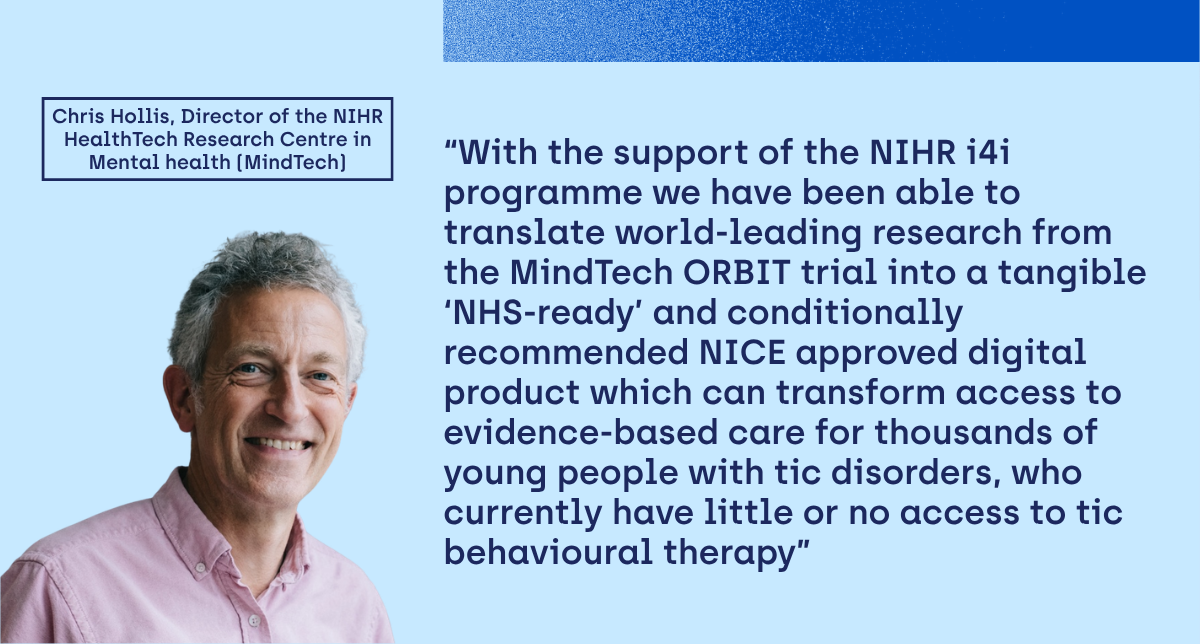
The ORBIT programme is already demonstrating significant impact for patients, healthcare services, and the wider NHS.
For children and young people, ORBIT offers access to specialist therapy that would otherwise be unavailable for many families. By delivering treatment remotely, the programme reduces geographical barriers and enables earlier intervention and support.
For families, the digital format offers greater flexibility and accessibility, helping reduce the burden associated with travelling to specialist centres.
Patient and public involvement has been central throughout the programme. Jigna, parent to a son with tics and an ORBIT PPI contributor, described the intervention as “a gamechanger” for her family, highlighting the real-world impact of improving access to timely care.
The programme is also supporting NHS workforce development. Clinicians involved in implementation have reported that ORBIT is helping strengthen clinical skills and expand the range of evidence-based support available to young people.
The impact pathway toward adoption is already well established. Following NICE’s conditional recommendation, ORBIT will begin rollout across five NHS sites in 2026, including Nottinghamshire Healthcare NHS Foundation Trust, Leicestershire Partnership NHS Trust, Lincolnshire ICB, North East London NHS Foundation Trust, and NHS Norfolk and Suffolk ICB.
This rollout will be supported through an NIHR i4i Transformative and Disruptive Innovations award, enabling a real-world evaluation of implementation, outcomes, and service impact.
The programme strongly aligns with national strategic priorities, particularly the NHS ambition to move from analogue to digital care delivery and improve equitable access to mental health services for children and young people.
What has the HealthTech Research Centre learned, and where do we go from here?
A major strength of the ORBIT programme has been its collaborative approach. MindTech played a central role in bringing together researchers, clinicians, industry partners, patients, and implementation experts to ensure the intervention was clinically effective, user-centred, and ready for adoption within the NHS. Patient and public involvement shaped the intervention throughout development, ensuring the platform reflected the real needs and experiences of young people and families.
The programme also demonstrates the importance of sustained support across the innovation pathway. Through multiple NIHR funding streams, MindTech supported ORBIT from adaptation and early development through to clinical evaluation, commercialisation, implementation planning, and NHS rollout.
The next phase of the programme will focus on real-world implementation and evaluation across NHS sites, while continuing to generate evidence required to secure a full NICE recommendation.
The team also aims to expand the platform into additional languages, helping improve access for more children and young people across the UK and internationally.
Who helped make this work possible?
The ORBIT programme is delivered through collaboration between the NIHR HealthTech Research Centre Mental Health (MindTech), the University of Nottingham, Nottinghamshire Healthcare NHS Foundation Trust, the Institute of Mental Health, Great Ormond Street Hospital for Children NHS Foundation Trust, Health Innovation East Midlands, the Centre for Healthcare Equipment & Technology Adoption (CHEATA), and Blüm Health Ltd.
The programme has been supported through multiple NIHR funding streams, including:
- NIHR Health Technology Assessment (HTA) Programme (Ref 16/19/02)
- NIHR Invention for Innovation (i4i) Product Development Award (NIHR205467)
- NIHR Invention for Innovation (i4i) Transformative and Disruptive Innovations Award (NIHR503712)
The team also worked closely with Tourette’s Action and received support from the NIHR Nottingham Biomedical Research Centre.
Further information: