

Executive summary
Stroke is a leading cause of death and disability in the UK, with over 100,000 cases each year and costs projected to rise to £75 billion by 2035. A key challenge in stroke care is the rapid identification of Large Vessel Occlusion (LVO) strokes, which require urgent specialist treatment but are difficult to diagnose in pre-hospital settings.
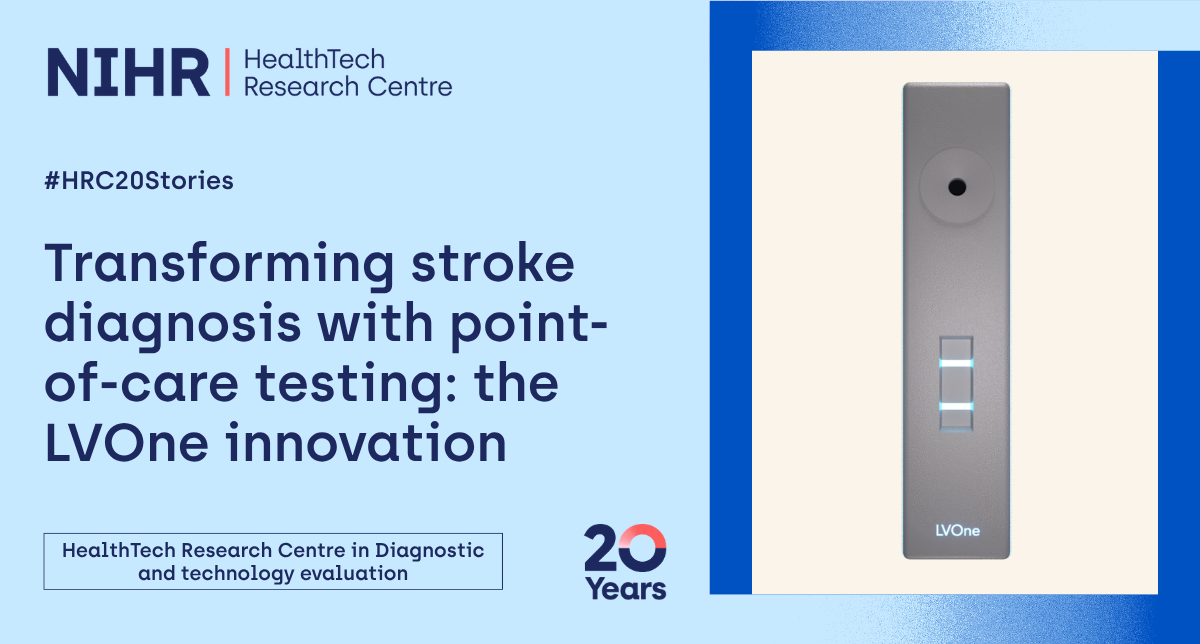
UpFront Diagnostics has developed LVOne, a rapid fingerprick blood test designed to identify LVO strokes in just 10 minutes. The NIHR HealthTech Research Centre in Diagnostic and technology evaluation (HRC DTE) has played a central role in supporting the development, evaluation, and progression of this technology from early-stage concept to real-world deployment.
Through collaboration with Newcastle University Stroke Research Group and industry partners, the HRC DTE has helped secure over £4 million in funding, generate clinical and economic evidence, and ensure the technology is shaped by real-world needs. Following UKCA marking in 2025, the LVOne test has now launched in the UK, marking a significant step towards NHS adoption.
Clear purpose and why
Large Vessel Occlusion strokes account for around 20% of all strokes but are responsible for a disproportionate number of deaths and long-term disabilities. Timely access to specialist treatment can significantly improve outcomes, but currently there is no reliable way to identify these patients in ambulances.
Patients are typically taken to the nearest hospital, assessed, and then transferred to a specialist centre if needed. These delays can reduce the effectiveness of treatment and lead to poorer recovery.
This project addresses a critical gap in the stroke pathway by exploring how a rapid, point-of-care blood test could enable earlier identification of LVO strokes and faster access to specialist care.
The HRC DTE has played a key role in generating the evidence required to support this innovation, ensuring it is clinically robust, economically viable, and designed for real-world NHS use. Without this support, the technology would face significant barriers to evaluation, regulatory approval, and adoption.

Watch how the device works on YouTube
Approach
The development of the LVOne test has been supported through a collaborative, multidisciplinary approach supported by the HRC DTE since 2018.
Working closely with UpFront Diagnostics and the Newcastle University Stroke Research Group, the HRC DTE team has provided statistical expertise throughout LVOne’s development, including clinical studies to evaluate the diagnostic accuracy of the technology in hospitals and ambulances. The HRC DTE team has also conducted health economic modelling to assess potential system benefits.
A strong emphasis has been placed on co-development with the project team including a public co-applicant with lived experience of stroke. They continue to work with the HRC DTE Insight Panel, rural communities, and the North East Stroke Patient and Carer Panel to ensure patient perspectives inform research design and delivery.
The HRC DTE Insight Panel of eight members have broad lived experience of the NHS and shaping diagnostic technologies to support patient care. In collaboration with the Glendale Gateway Trust, the HRC DTE have co-hosted two activities with eight people living in rural areas as these communities could be most affected by the model of re-directing patients to specialist centres. Through also engaging with the North East Stroke Patient and Carer Panel, who have experience of emergency stroke care, the project team have confirmed acceptability of the test with a wide range of people. Their feedback has shaped the test development, clinical study design and applications for ethical approval.
Clinicians and ambulance services were also involved early, providing insight into how the test could be used in emergency settings and identifying practical considerations for implementation.
This approach has ensured that the technology is not only scientifically robust but also usable, acceptable, and aligned with NHS care pathways.
Findings
Emerging evidence from clinical studies supports the use of blood-based biomarkers to identify LVO stroke rapidly and accurately. Research has demonstrated that specific biomarkers can distinguish LVO stroke from other stroke types, providing a foundation for point-of-care diagnostic tools.
The LVOne test builds on this evidence, translating it into a simple, rapid test that can be used in pre-hospital settings. The test can be completed in approximately 10 minutes using a fingerprick blood sample and does not require complex equipment or specialist training.
Studies supported by the HRC DTE are evaluating the diagnostic accuracy and real-world feasibility of the test, with early findings indicating strong potential to improve pre-hospital triage decisions.
The technology has now achieved UKCA regulatory approval and has been launched in the UK, demonstrating readiness for real-world use and progression beyond the research setting.
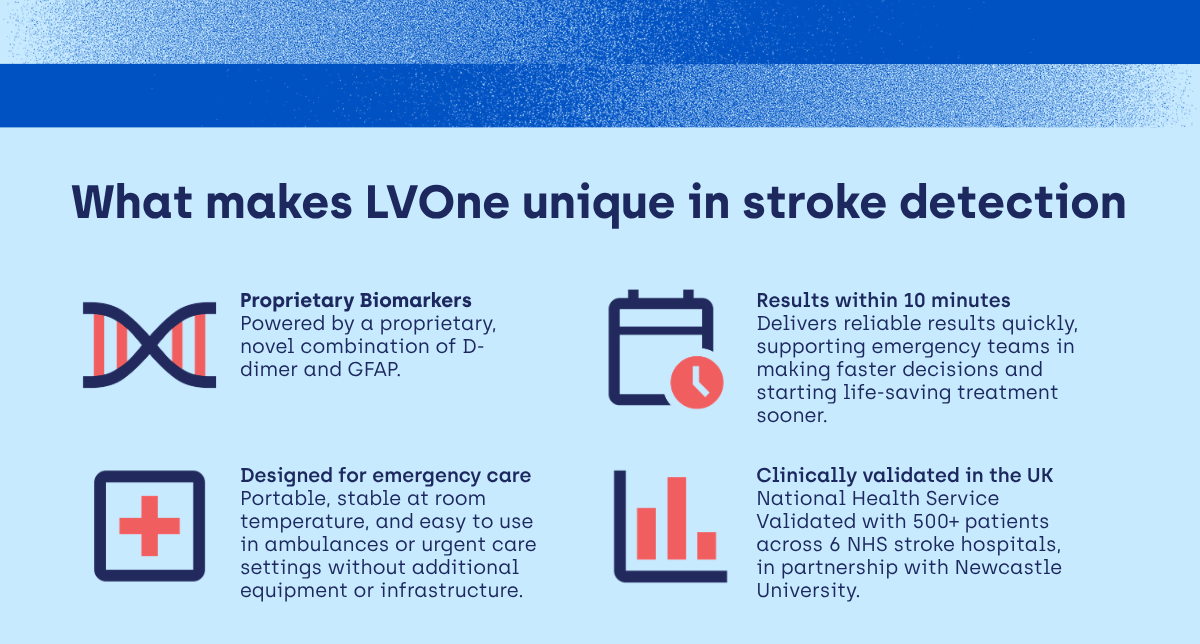
What makes LVOne unique in stroke detection
Insights and impact
The impact of the LVOne test is being realised across patients, the healthcare system, and the wider economy.
For patients, earlier identification of LVO stroke could mean faster access to life-saving treatment. In practical terms, this could lead to improved recovery, reduced long-term disability, and better quality of life.
For the NHS, the test has the potential to transform the stroke pathway by fast-tracking patients to specialist treatment. This can reduce delays, reduce the impact of hospital transfers, and improve the efficiency of emergency care. For every 15-minute reduction in time to treatment for LVO patients there is a 20% increase in chance of good recovery.
Economic modelling suggests that routine use of the test could reduce NHS and social care costs, as well as the wider economic burden of stroke, including unpaid care and lost productivity.
The collaboration has also delivered significant innovation and commercial impact. With support from the HRC DTE, UpFront Diagnostics has taken its technology from the early research stage all the way through to a stage where it has been tested and proven in real-world settings.
In other words, the idea has moved from the initial scientific concept (Technology Readiness Level 1) to a working product that’s close to being ready for wider use (Technology Readiness Level 7).
They have also secured over £4 million in funding from Small Business Research Initiative (SBRI) Healthcare and Innovate UK, and in 2025, achieved UKCA marking - a certification that shows their product meets UK safety, quality and performance standards, allowing it to be used more widely across the healthcare system.
The recent UK launch of the LVOne test represents a key milestone in the pathway to adoption. Moving beyond research into real-world deployment demonstrates both the maturity of the technology and the strength of the supporting evidence. It signals a clear route to NHS implementation, supported by ongoing evaluation in ambulance settings and engagement with system partners.
Adoption is already being actively progressed. The technology is now being evaluated in real-world ambulance settings through a £500,000 SBRI study, which will provide critical data on accuracy, usability, and cost-effectiveness to support NHS integration.
This work aligns with key NHS strategic priorities, including earlier diagnosis, the use of innovative technologies, and delivering faster, more targeted care closer to patients.
Reflections
A central strength of this project has been its commitment to co-development. By involving clinicians, ambulance staff, patients, and researchers from the outset, the technology has been shaped around real-world needs.
Engagement with ambulance personnel has been particularly important, ensuring the test is practical in time-critical emergency settings. Patient and public involvement has ensured the research remains focused on outcomes that matter most.
Partnership working has accelerated progress. Collaboration with Health Innovation North East North Cumbria has supported planning for adoption and procurement, helping to bridge the gap between innovation and implementation.
The progression from early-stage research to UK launch highlights the importance of sustained support across the innovation pathway. The NIHR HRC DTE has played a critical role in enabling this transition, ensuring that evidence generation, user engagement, and system alignment have progressed in parallel.
Next steps
The ongoing SBRI project will generate real-world evidence in ambulance settings to support NHS adoption of the LVOne test.
This includes evaluating how accurately the test identifies patients with LVO stroke, understanding practical challenges for ambulance teams, and quantifying potential cost savings.
These findings will inform decisions on implementation, scaling, and integration into stroke care pathways.
The test is also currently being deployed by London Ambulance Services in a six- month pilot study.
Affiliations and links
This work is delivered through collaboration between the NIHR HealthTech Research Centre in Diagnostic and technology evaluation (HRC DTE), UpFront Diagnostics, and the Newcastle University Stroke Research Group.
The HRC DTE has played a central role in supporting study design, statistical analysis, health economic modelling, and patient and public involvement. UpFront Diagnostics has led the development of the LVOne test, supported by academic and clinical partners.
Additional collaboration with Health Innovation North East and North Cumbria is supporting adoption and implementation planning.
Together, these partners are enabling the development of a technology with the potential to transform stroke care and improve outcomes at scale.